Friday, November 17, 2006

Some words on the Streets

I followed Aaron Naparstek from naparstek.com over to his current operation Streetsblog. While Streetsblog is primarily concerned with New York City transportation issues, it also presents a big picture view that's valuable to folks who live elsewhere. Or, as another streetsblog reader put it in this post:
I wanted you to know that Streetsblog, despite its New York City focus, has an impact beyond. I have a much broader set of analytical tools to bring to bear to my small problem and the larger bike and pedestrian issues that I am beginning to become involved with.

Streetsblog's regular "Today's Headlines" feature aggregates news stories from across the country. I've even suggested one that Aaron picked up. Those who don't live in New York should still consider spending some time on the Streets.

Thursday, November 16, 2006

The bane of motorists

To all bicyclists using major arteries as most Americans are going to, or leaving work,
GET OFF THE ROAD!
-- Michael, Penfield, NY.

I usually assume that motorists pull out in front of cyclists or pass them too closely because they don't see them. Michael provides a timely reminder that some people endanger cyclists because they do see them. I discovered his "Bicyclists: The Bane of Motorists" because he included a link to Bike Year, describing it as good place to check out "lots of bike-crybabies."

Maybe Michael's not as troubled by bicycles as he claims to be. Perhaps he's demonstrating his crankiness in hopes of scoring a sidekick gig on a small market classic rock station's morning zoo crew. But let's pretend he's for real. His chief complaints, as far as I can tell, are:

1. He doesn't like it when cyclists ignore traffic regulations.
2. He disapproves of their fashion choices.
3. He hates sharing the road with slower vehicles.

I can dig what Michael's saying on the first point. Although I would include not just cyclists, but all vehicle operators who ignore traffic regulations. As for the second point, I'm occasionally amused by the costumes some folks don before going for a ride, but their clothes don't anger me as they do Michael. On the third point, he excuses the slow pace of tractors and construction equipment, noting that "they are almost always used for work, not transportation," but he can't stomach the idea of following a bicycle until it is safe to pass.

He thinks bikes aren't fast enough for public roads. I think cars are too fast for public roads. And so it's here that Michael and I can find no common ground. Or can we?

I have a solution that will work for both of us. Instead of the "bike-free" roads or "bike's only" lanes Michael proposes, a more practical solution is strict enforcement of 25 mph speed limits for all vehicles. That way, the gap between bicycle and car speed virtually disappears.

Michael might be happier traveling at a less frantic pace. He wouldn't be forced to "lock down on" his brakes after "rounding a difficult curve." There's not much call for brake lock downing at 25 mph. He will also find the difficult curves easier to negotiate at lower speeds. On the other hand, what about those times Michael wants to go faster? Well, unless he's using his Honda Accord as some sort of freelance ambulance, there's simply no justification for speeding. After all, cars are almost always used for transportation, not work.

Wednesday, November 15, 2006

Three months later

I'm still riding my bike. Just not the same bike. But more on that later.

The big transportation news here in Savannah is the Georgia Department of Transportation's plan to widen Abercorn Street Extension on Savannah's south side. The possibility of more lanes has been reported by local television news operations with barely concealed glee. An editorial in today's Savannah Morning News introduced its position on widening Abercorn and other commuter routes with this:

"Rush-hour drivers have probably considered just leaving their vehicle on Ga. Highway 21 and walking to work."

Of course, this is another example of a perfectly acceptable method of transport likened to some sort of deviant behavior. To be fair, it would be unreasonable for a person with 50 mile round trip commute to try walking to work. But is it any more reasonable for motorists to expect quick and easy passage twice a day through 25 miles of sprawl, amidst thousands of other single occupant motor vehicles?

But adding more lanes will solve the problem, won't it? It seems unreasonable to think so. Like the man says, "Trying to cure traffic congestion by adding more capacity is like trying to cure obesity by loosening your belt."

Tuesday, August 15, 2006

The new (old) bike

The green L.L. Bean hybrid bicycle that appears to the right is no longer with me. Last month I sold it in an effort to reduce my bicycle inventory (mine was a two person, seven bike household). This initiative also included the sale of my 1979 Peugeot UO-10 single speed conversion.

There was really nothing wrong with the Green Bean. It was a perfectly serviceable bike. The bottom bracket was starting to get a little creaky, but other than that, it was mechanically sound. I've heard that the new owner is making good use of it. I just wanted a change.

Since the sale of the Green Bean, I've been using two of my remaining three bicycles for my commute. One is a 2005 Raleigh M40 DX, which I'll be become my primary bike after I complete some alterations (more on that in a future post).

In the meantime, the bicycle I'm riding most often is a 1979 Peugeot UE-8.


Well, most of 1979 Peugeot UE-8. Students of bike boom Peugeots will notice that several parts are missing and detect a number of alien components that are not native to this bike. For the most part, however, it's pretty much what you got in an entry level bicycle 30 years ago. In other words, it wasn't exactly high tech, even back then. Still, it's almost perfectly suited for commuting and a lot of run to ride.

Wednesday, August 09, 2006

Seven miles and two costume changes

In the crazy world of bicycle commuting, there are people who commute 30 miles or more everyday in all kinds of weather. Commutes of this kind generally require cycling-specific clothing, access to showers and lockers at work, and plenty of willpower. My roundtrip, by comparison, is around five miles. Except for today. I've already ridden more than seven.

Today I rode to work with my wife's keys in my pocket. Just as I reached the office, she called to report she was locked inside the house. I pedaled -- double-time -- back to the house to release her so she could go to work. On arrival at home, I was more moist than I would prefer to be at the beginning of the workday. So I had to cool down and change into dry clothes before heading back to the office.

I've commuted to work by bicycle almost every day for almost a year. During this time, my decision not to drive has created few negative consequences for me or my employer. Still, on hot and humid days like today, it would have been much easier simply to turn the car around and zip back to the house.

Tuesday, August 08, 2006

Remember me?


I am alive and riding. And I'm planning to resume regular posting soon. But first, a bit of news. I've recently learned that the first ever Georgia State Bicycle & Pedestrian Conference is scheduled for Oct. 24 and 25 at the Holiday Inn in Decatur. Sounds like there are some good sessions on tap, including:
  • Bicycle, pedestrian and multi-use trail facility design
  • Traffic calming
  • Updates from the GDOT and Federal Highway Administration
  • Best practices from bike and pedestrian friendly communities
  • Bike, pedestrian and greenway planning
  • Funding sources
  • Safe Routes to School programs
  • Economic development and tourism
  • Travel Demand Management
  • Data collection and analysis
  • Mobile bike/walk workshops
And of course:
  • More
Additional information can be found here.

Tuesday, June 27, 2006

On the road

Once upon a time:
"Most people living in cities didn't think fast cars belonged in streets. When cars hit pedestrians, it was always the driver's fault."
Then:
"But some people wanted to give cars a rightful claim to street space. By casting doubt on pedestrians' place in the street, it strengthened cars' claim to street space."
Until:
"By 1930, 'jaywalker' was routinely applied to pedestrians engaging in street uses that had once been beyond reproach. By then most people agreed (readily or grudgingly) that streets are chiefly motor thoroughfares."
And now:
"For the past century, America's love affair with automobiles has meant that motor vehicles have ruled American streets. Despite sporadic efforts to assert the rights of pedestrians and bicyclists, that culture prevails."


Yet, some are hopeful:
"While America's roads may be perfect for gas-guzzling cars and disposable travelling, they don't have to be used that way."

And some are helpful:
"State highway departments have been taking big roads and narrowing them, adding bike lanes and trails. In the last 10 years, engineers have increasingly looked for ways not to speed cars along but to slow them down."

A Slow-Road Movement?

Thursday, June 22, 2006

The end is near


Since I started this blog 357 days ago, these are some of the things that have happened:

  • I replaced 1,188 miles worth of car trips with bike trips.
  • I still drove a lot more than I should have.
  • I was hit by a car.
  • I was nearly hit by a board thrown from a second floor window.
  • I met new friends online and on the street, who encouraged me.
  • I met angry motorists, who yelled, "Get off the road!"
  • I waved to other cyclists.
  • I wished there were more cyclists to wave to.
  • I sweated a lot.
  • I shivered a little.
  • I almost witnessed a motorhome vs. riding lawnmower accident.
  • I accidently left my bike lock at home almost a dozen times.
  • I tried to finish "Effective Cycling" by John Forester.
  • I finished "The Art of Urban Cycling" by Robert Hurst.
  • I got caught in the rain.
  • I got my pants leg caught in the chain.
  • I developed basic bicycle maintenance skills.
  • I developed a great respect for professional bicycle mechanics.
  • I was startled when motorists blew their horns at me.
  • I startled motorists by blowing my horn at them.
  • I became used to seeing cars parked in the bike lane.
  • I learned that some cyclists hate bike lanes.
  • I frequently regretted getting behind the wheel.
  • I never regretted getting on my bicycle.

Above all, I came to realize that using a bicycle for life's everyday tasks is not really such a big deal. Riding to work, to the grocery store and to other everyday destinations has been relatively easy for me. What started out as a significant lifestyle change is now the norm. That's not to say that my fellow citizens have also become avid utility cyclists. The choice I made last July makes me a rather odd specimen among my neighbors, my friends and my coworkers. But it's become normal for me.

And that's why I must decide, in the next couple days, what to do when the Bike Year ends. Should I continue the blog? If so, what direction should it take? I welcome suggestions.

Tuesday, May 23, 2006

Takin' care of business

At around 8:15 this morning I passed a pedestrian strolling down Lincoln Street. Dude looked at me, held up his Budweiser tall boy and shouted, "The businessman riding his bike to work!"

Well, I've have worse things yelled at me.

Monday, May 15, 2006

Cars gone wild!

Aaron Naparstek has a fascinating post on his blog about a "parking squat" held in Park Slope, Brooklyn. The concept is fairly simple. Squatters feed the parking meter, set up lawn chairs and small tables, then simply hang out and enjoy the space until the meter expires. According to Naparstek, the purpose of the squat is to challenge "the idea that the vast majority of a crowded city's street space -- its public space -- is best used for the storage and movement of private automobiles." And it looks like the squatters had a great time.

Here in Savannah, the parking squat is a little different. You might even call it a reverse parking squat. In our local version, a motorist claims an area of public space such as a sidewalk or crosswalk to support "the idea that the vast majority of a crowded city's street space -- its public space -- is best used for the storage and movement of private automobiles."

In downtown Savannah, most parking squatters eventually attract the attention of the city's Parking Services department, but outside the National Historic Landmark District (and even some places within it), motorists can squat without fear of receiving citation. Meanwhile, these squatting cars create a nuisance for most pedestrians and, for citizens with sight or mobility impairments, they constitute a real danger.

I've decided to document these parking squats in a series I'll call, "Cars Gone Wild!"

If you zoom in on this photo, you'll see from the tag on the bumper that this car's name is Centipede. Like a lot of older model Dodge Neons, Centipede is feeling a little under the weather these days and doesn't have the energy to drive around searching for parking space in this neighborhood on the east side of the historic district. A nice resting space on the sidewalk is just the place to for a weary car to relax and await its next assignment. Hope you feel better soon, Centipede!

Thursday, May 11, 2006

The Voice of the People

I wonder how many newspapers have gripe lines like the Savannah Morning News feature called "Vox Populi." There's the Atlanta Journal-Constitution's "The Vent," which has been around for at least 10 years now. Most Vox contributions sound to me like recycled sound bites originally hatched on talk radio, but sometimes they are wonderfully random. For evidence, I submit these to shining examples from the last couple days:

"Does anyone remember the old peanut man who had a house on Skidaway with a peanut field right behind it? He sold peanuts on his front porch."

"I went to the hospital recently with acute diverticulitis and the doctor accused me of being a drug seeking person. Fortunately he named a pill I had at home so I went home and took that. I'm glad I didn't have something more serious. Doctors, don't assume everyone is a drug addict."

Still, if we filter out wistful nostalgia for peanut men and accounts of digestive ailments and pill naming, we can sometimes catch a glimpse of the bees residing in Savannah's collective bonnet. An installment last week featured two sentences that tell us pretty much all we need to know about how locals view the increased cost of motorcar operation and the viability of bicycling and walking as possible alternatives. Here it is:

"When are we going to get sidewalks and bike trails for when we can no longer afford to drive cars? How else are we to get to work, church and the grocery store?"

This comment conveys two central ideas. First, it represents the view that bicycles belong on trails and not on city streets. I'll give the author the benefit of the doubt by assuming that he or she is advocating sidewalks for pedestrians. However, comments screamed from passing cars at many of my cycling friends (but never at me, for some reason), suggest there's very good chance he or she expects cyclists to use these sidewalks. Second, it's a classic example of the kind of hyperbolic statement frequently deployed by Vox Populators, who figure things have gone too darn far. Here's one I just made up:

"I had to wait so long in my doctor's waiting room, next time I'm bringing a tent and a sleeping bag."

Of course, my impatient patient isn't really going to take camping gear to his next checkup. Nor is the Vox Populi contributor actually suggesting that people will walk or ride bicycles as gas prices rise. Clearly something must be done before the situation declines to such a grim point. The idea of walking to work is preposterous. Riding a bike to a grocery store? Don't be ridiculous. There must be an intermediate solution that's less crazy. Like driving around in golf carts!

Despite an endless parade of newspaper and television stories about high gas prices, I detect few changes in the behavior of my fellow citizens. Large SUVs are still left idling curbside for indefinite periods. Fuel-wasting aggressive driving remains popular among motorists of all demographic groups. Clearly gas prices are failing to cramp our styles.

On the other hand, yesterday I was a part of miniature bicycle traffic jam. Our convoy was led by an older gentleman on a cruiser with twin wire baskets on the back. Next was the rarest of all cyclist species: a commuter, dressed in office attire with a messenger bag slung across his back. And me. We were all in a pack, heading north on Lincoln Street, just a couple bike-lengths separating each of us. At Gwinnett Street we were joined by another cyclist who veered onto Lincoln and headed south against traffic. He was riding a creaky mountain bike that looked like it had spent about twelve parsecs in the cargo hold of a Jawa Sand Crawler (they guy sort of looked like he'd been in there, too). He weaved in and out of parked and oncoming cars as we cruised by.

For that one block, cyclists outnumbered motorists by a factor of four to one! I figure gas prices will have to get a whole lot higher before this becomes the norm.

Wednesday, May 03, 2006

Desperate to stay behind the wheel

South Carolina's The State newspaper reported yesterday that State Rep. Todd Rutherford has ditched his BMW in favor of a golf cart for his daily commute to work. The Democrat's motivation, according to the story, is to avoid paying high gas prices. He started using the golf cart during the Great Hurricane Katrina Gas Price Spike of Ought Five.

Seems like a pretty smart fellow, taking advantage of a South Carolina law that permits daytime golf cart operation on secondary roads, as long as the cart is not driven more than two miles from a home or office. And that's the part that gets me: Rep. Rutherford lives a mile and a half from his office. Why isn't he riding a bicycle? Or even walking?

The photo and biographical information posted on his Web site indicate that Rep. Rutherford is my age or younger. Unless he has a physical condition that necessitates use of a motorized vehicle, why does he constrain himself to a golf cart when he could surely get to work under his own power? Could it be the heat? I have it on good authority that Columbia can be one of the hottest places in the known universe. Nope. High today should be around 89 degrees.

I think this might be the problem:

He said its only draw back is its lack of speed. He drives to the side to keep from being run over.

If he's worried about being hit in "his caution-yellow E-Z-GO," imagine how people on bicycles must feel! I appreciate this lawmaker's dedication to conserving fuel, but with such a short commute, I encourage him to leave the car and the golf cart in the garage. If I can do it, why can't he?

Wednesday, April 19, 2006

It's not easy being green

Thomas Friedman was on the Today Show this morning. He suggested that it would be a good thing if oil topped $100 a barrel as this would lead Americans to make other arrangements, as Kunstler might say. Faced with record high gasoline prices, he said, we would drastically change our habits. We would consume less oil. We'd make smarter choices about the types of cars we own. His theory goes something like this: Conservation would reduce demand, thus dropping the price of oil, which would allow us to stick out our collective tongues at Iran and other oil producing nations.

I hate to tell this to Friedman, but behavior modification will be a difficult assignment around these parts.

A local LEED-certified shopping center has recently become the subject of public scorn. Callers to the Savannah Morning News' "Vox Populi" gripe line have promised to boycott businesses in the Abercorn Commons, home to the planet's first LEED-certified McDonald's restaurant. The project's developer seems be doing everything right, from recapturing rainwater to energy efficient HVAC schemes to using recycled construction materials. It's the sort of development lots of cities would be proud to have, as Andre recently pointed out on his excellent blog.

What made the folks so angry? Some of the spaces in the permeable surface parking lot are set aside for hybrid cars. Here are some samples from Vox Populi:

"The 'Hybrid Vehicles Only' parking is ridiculous."

"Politically correct parking spaces for politically correct cars? I am physically handicapped and will spend my money elsewhere because I do not feel welcome there."

"I've been looking forward to the new stores but I don't drive a hybrid car, whatever that is, so I won't be shopping there."

With loyal customers like these, oil companies have little to worry about.

Tuesday, March 14, 2006

Leading cyclists in the wrong direction


Last week on the way to work, I saw a friend who was also commuting by bike. A couple days later, I talked with him on the phone and found that he rides to work pretty often. Why hadn't I seen him before? Because our paths diverge just north of Victory Drive. He joins the northbound Lincoln Street while I remain on Habersham Street.

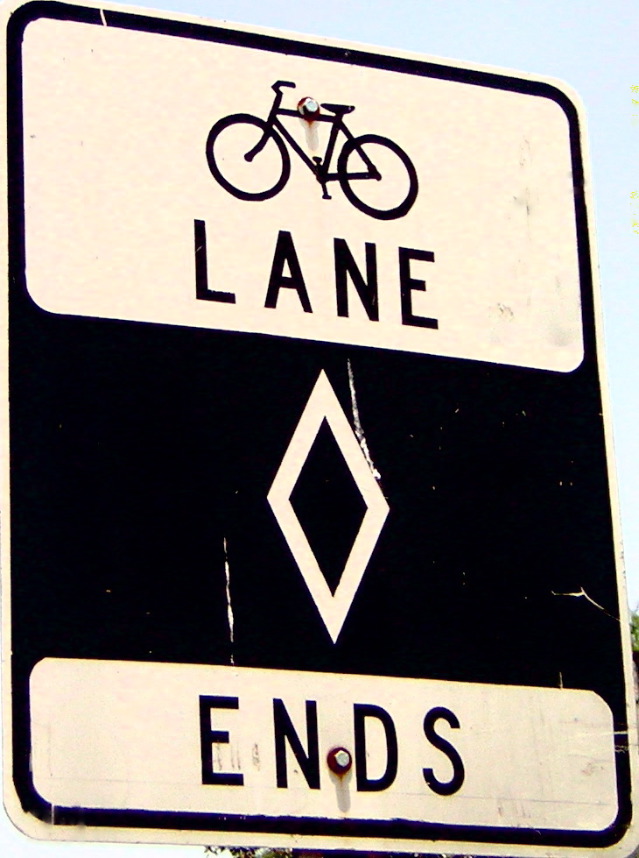
He asked why I didn't follow the bike route and my answer was simple: wrong-way cyclists. As I have mentioned in previous posts, the Lincoln Street bicycle lane is on the left side of a northbound one-way street. Because it's the only marked bicycle lane in downtown Savannah, it naturally attracts cyclists and even those who need to go south. This forces them to ride against automobile traffic, which seems particularly dangerous at cross streets where motorists look for traffic originating from the south, but not necessarily the north.

It also requires northbound cyclists to play chicken with their southbound counterparts, which is why I steer clear of it all together. Here's one of the obstacles that I'd have to negotiate on my daily commute, if I used Lincoln Street. Add in a southbound cyclist nearing the tree at the same time and the game of chicken becomes even more exciting.


And, as the following photograph suggests, the bicycle lane provides very convenient parking for motorists.


The bicycle lane terminates at the intersection of Liberty Street, at which even law-abiding northbound bicyclists find themselves instantly on the wrong side of the road, facing oncoming traffic. (Lincoln becomes a two way street at this point). Turning right onto Liberty Street also presents problems for the northbound cyclist at this busy intersection.

But perhaps I'm making too much of this wrong-way cyclist thing.

Lincoln Street does have some advantages. First, there are stop signs at the intersections of Anderson and Henry streets. This would probably make my commute quicker, as I would not have to wait for the traffic signals to change as I do on Habersham Street. This, by the way, seems to make motorists very uneasy. I suppose they are so used to seeing bicyclists blow the lights that they are freaked out when I don't.

Finally, there is something to be said for the idea of strength in numbers. Because Lincoln Street is popular with cyclists, perhaps motorists are more used to seeing them on the road. I am considering using Lincoln Street on my morning commute. Because I'm convinced riding against traffic is a terrible idea, I'll keep using Habersham Street on the way home. Anyone else out there have experience using "one-way" bike routes?

Friday, February 03, 2006

Breeding more bicycles

Earlier this month, Bill Dawers wrote about the demolition of the City Market Parking Garage in his Savannah Morning News "City Talk" column. It was the destruction of City Market, for which the garage was named, that helped to spark Savannah's preservation movement in the mid 1950s. Lots of folks were happy to see the garage bite the dust. Commenting on a shuttle system deployed to soothe motorists until the new underground parking facility is built in its place, he wrote:

In many cities, commuters would think nothing of walking from Liberty and Jefferson streets, rather than taking a shuttle, but Savannahians are simply not accustomed to walking that far.

This is a puzzling, but very real phenomenon. Visitors travel from all over the globe to stroll the streets of the National Historic Landmark District, but to many locals, the idea of walking several blocks, through one of the most beautiful cities in the world, is intolerable.

And even if the city continues to add to its structured parking inventory, will it ever be able to keep pace with demand? If you believe Atlanta Journal-Constitution columnist Cynthia Tucker (and I do) the answer is no. If fact, she suggests that more parking breeds more cars. Writing last year about parking garages proposed for Atlanta's Piedmont Park, she observed:

Atlanta and every other Sun Belt city from Los Angeles to Orlando give the lie to the theory that it's possible to solve the issue of traffic and parking congestion by building more roads and more parking spaces. New roads and garages are the opposite of clothes dryers, where your socks are frequently kidnapped by forces unknown. Instead, cars self-multiply when you build more highways and garages. Park 10 in a garage overnight, and you'll have 15 in the morning.

Could the city of Savannah use this equation to it's advantage? If it provided free, secure, convenient, covered parking for bicycles, would more people consider riding bicycles around the National Landmark Historic District and thus reduce pressure on automobile parking resources? It's true that bicycles can be easily locked to parking meters, signposts and fences. But as a person who rode to work this morning on a saddle still soaked by yesterday's rain, I can tell you the idea of covered parking is appealing.

Take a look at this photo of what I believe to be the only covered bicycle storage facility in downtown Savannah. Like virtually all bicycle racks in town, it is provided by the Savannah College of Art and Design and is free to use by students and non-students alike. It's safe to assume that most of these bicycles belong to students visiting the Jen Library, where the racks are located. But not all of them are.

Would Tucker's equation work for bikes? If you parked 10 at night, would you find 15 in the morning? Of course you'd have to figure a certain number would be lost to bicyle theivery, a thriving local cottage industry. Still, if parking decks attract more cars, then properly located and configured facilities should attract more bikes.

Wednesday, February 01, 2006

Former dealer warns users about addiction

I didn't watch President Bush's fifth State of the Union Address last night. But I read it on his Web site this morning. This is my favorite part:

A single chemical reaction between hydrogen and oxygen generates energy, which can be used to power a car -- producing only water, not exhaust fumes. With a new national commitment, our scientists and engineers will overcome obstacles to taking these cars from laboratory to showroom, so that the first car driven by a child born today could be powered by hydrogen, and pollution-free.

Sounds pretty darn simple to me. A single chemical reaction? How hard could it be? Sort of difficult, it turns out.

This morning, the Savannah Morning News printed a story by Associated Press reporter Jennifer Loven. Here's a snip:


"America is addicted to oil, which is often imported from unstable parts of the world," Bush said.

Our president has crafted a very instructive analogy: We are addicted to a drug called oil. And he should know. He's a former dealer. His observation about the oil coming from unstable parts of the world is also very keen. To feed our addiction, our Uncle Sam is constantly looking to score and that takes him into some of the sketchiest neighborhoods on the globe. He's obligated to do business with some pretty unsavory characters, all to make sure we don't go into withdrawal.

It seems to me, however, that even if we do manage engineer our nation's fleet of private automobiles to burn hydrogen, ethanol or Jesus Juice, we are essentially swapping one addiction for another. Instead of the street drug (oil) we'll be hooked on the pharmaceutical-grade stuff that Bush says his proposed 22 percent increase in clean energy research will deliver. And we will still have many of the same problems, at least in my town.

Hydrogen-powered vehicles will be lined up for miles in the eastbound lanes of Interstate 16 every workday morning. Neighborhoods will be bulldozed and all kinds of other expensive schemes floated to maximize ethanol-fueled vehicle volume and speed on Derenne Avenue. Owners of alternative fuel vehicles will still be clamoring for more structured parking in the National Historic Landmark District.

What if you can't afford to purchase or lease one of these new "clean" cars? What if a medical condition prevents you from operating one of these advanced vehicles? I'm sorry, friend, but in the future you'll be treated like a second class citizen, just as you are now.

Friday, December 30, 2005

My mind is in the gutter

There is a segment of the bicycling community that opposes the creation of bike lanes. One of the main gripes against bicycle lanes is practical: Bike lanes become repositories for road debris, which is particularly damaging to bicycle tires. Another argument is more philosophical: Bicycle lanes segregate cyclists to separate facilities. This is a slippery slope, they fear, ultimately leading to the exclusion of bicycles from streets without bicycle lanes. Some folks say, bike lanes are bike ghettos. It's a compelling argument.

I use my city's only north-south bicycle lane on a daily basis, except the portion that runs along Lincoln Street. Lincoln is a one way street running north, making it completely inappropriate for a bicycle route. I quickly learned that riding my bicycle with traffic (as state law requires) would place me on a collision course with a relentless parade of wrong-way cyclists. No thanks.

Lately I'm becoming sympathetic to the first argument against bicycle lanes. South of Victory Drive, the Habersham Street bicycle lane is full of leaves. Some of these leaves have fallen directly from trees. Others have been moved from the yards of homes (including the yard of one prominent local official) into the bicycle lane.

These leaves don't pose much of a problem for me, as I usually ride on the left edge of the lane. However, they are a potential hazard for nighttime and rainy weather cyclists. Admittedly, this situation is seasonal. Once the trees have ejected all their leaves, the danger will diminish. However, in the spring the leaves will surely be replaced with mounds of grass clippings.

Other objects can be found in the bicycle lane at all times of year. I'd like to think that this truck was parked this way in an attempt to leave a portion of the bike lane clear. But I'm doubtful of good intentions in this case. The end result is that this truck is blocking a portion of the bicycle lane and all of the sidewalk. A police officer could have cited the owner of this truck for two different violations. I wonder how many police cruisers passed this location while the truck was parked there.

On a more positive note, while I was waiting at a traffic signal this morning a cyclist pulled up behind me. I turned around and said good morning. Not only was she riding on the correct side of the steet, but she also waited for the light to turn green! These two actions placed this cyclist delightfully at odds with most of the other bicycle operators I see every day. It was an after Christmas miracle!

Friday, December 23, 2005

Hari's today, gone tomorrow

Since I've been commuting by bicycle, I've seen two new restaurants open for business, watched the rehabilitation of a dilapidated house, and observed other houses become more dilapidated. Yet, I try to resist focusing too much attention on the residential and commercial structures I pass each day. Why? Because I have yet to encounter a building that was racing to beat me to the next traffic signal, stepping off the curb in front of me, or rolling straight toward me in the bicycle lane. There are plenty of motorists, pedestrians and wrong-way cyclists to perform those tasks, so I try to stay attentive to them.

One building I feel safe in inspecting closely is Hari's Food Store, a formidable contender for the title of Savannah's least attractive convenience store.
The reason I got into the habit of surveilling Hari's is this: It is source of successive waves of automobiles that flow into the roadway. The operators of these vehicles seldom show much regard for approaching cars and display absolutely none for approaching bicycles. I've found it pays to keep an eye on Hari's and prepare for evasive maneuvers, whether one is traveling down Habersham Street by bike, car, truck, sports ubiquity vehicle or M1 Abrams Main Battle Tank.

Last week, I noticed something different about Hari's. There weren't any cars were streaming out of the parking lot into my path. In fact, the store was locked and completely empty. While the lights were still on, the interior of the store was clearly devoid of shelving and merchandise.

One of my coworkers lives less than 200 yards from Hari's. I've heard him complain about Hari's for a reason different from my own: It is the source of successive waves of honey bun wrappers, empty beer bottles and losing scratch-off tickets that wash ashore in his front yard. I figured he'd be pleased that the place was locked up. When I asked him about it, he said he had no idea Hari's was closed.

Cars insulate us not just from the weather, but from the life of the neighborhoods through which we drive. To become aware of the subtle day-to-day changes in our communities, a different sort of vehicle is required. I'm lucky that I get to use such a vehicle almost every day.

Thursday, December 15, 2005

More posting than riding

Yesterday I wrote that I couldn't remember the last time I drove to work. But I can remember the last time I was driven to work. That was today. The threat of heavy thunderstorms and an office function at which unwet clothing was required kept me off my bike.

On the way to work not a drop of rain hit the windshield. Looks like the skies are clearing now. But that doesn't matter. I don't care if I get wet on the way home.

Tomorrow I ride!

Wednesday, December 14, 2005

More riding than posting

The lack of activity on this blog could be interpreted as a sign that the Bike Year is over, that I abandoned the experiment. But, actually, the opposite is true. I've continued to ride on almost a daily basis. I honestly cannot remember the last time I drove to work.

Using my bicycle for tasks that previously would have placed me in the driver's seat is not really an "experiment" these days. It's part of my daily life. And I suppose that's why I haven't felt compelled to post in recent weeks. It all seems so unremarkable. I now understand why Bike Year hasn't attracted many visitors. It isn't terribly interesting. In fact, I guess it's pretty boring.

Still, as I peel months off the calendar, I've become aware that even though utility cycling has become my routine, it is always changing. The big change lately is the weather. Having lived in South Georgia and North Florida for most of my life, I've never owned a decent pair of gloves. Even when I lived downtown and walked a lot, I never bothered with gloves. After all, they are already sewn into jackets in the form of pockets.

Now, on cold mornings, I'm gripping the handlebars through $3 gloves I found years ago on the clearance table at the GAP. Finally I know why they were so cheap (aside the probable child labor and all that). These are not gloves, but more like hand costumes. They give the impression that I'm wearing gloves in much the same way that the Halloween costumes sold at K-Mart when I was a boy conveyed the notion of characters from "Star Wars." The wearer of the thin plastic jumpsuit with an image of C3PO on the chest was never mistaken for a real robot, nor did he or she ever really feel like a robot. In much the same way, my cold hands are acutely aware that they are not wearing real gloves, but merely an homage.

Wednesday, November 23, 2005

Different destinations, same mileage

When I started this blog back in July, most of my cycling was done after work. Back then, Savannah's legendary heat and humidity made it impossible for me to commute to work in business attire. As a result I did most of my cycling after work in the form of rides to the grocery store, minor league ballpark, library, restaurants, bike shop and video rental store. I wasn't wearing a suit and tie on these trips.

Since sometime in late September (I really should have kept track or this), most of my rides have taken me to work and back. It's been a very dry fall and I've taken full advantage of this by commuting to the office almost every day. Once I arrive at home, the bike goes into the shed and it usually doesn't emerge until the next day. Nonetheless, I don't think I'm driving more, even though I've cut back on riding after work.

What's happening, I've discovered, is that I'm bundling my trips together. I'm shopping more often at the Gwinnett Street Kroger, which is between my house and the office, and less often at Publix, which is about two miles south of my home. I'm taking care of errands along my commuting route. I'm also shopping more on foot during my lunch break.

Wednesday, November 02, 2005

The view from the Habitrail

I've recently returned from a five day visit to Kansas City, during which I saw three bicyclists. But perhaps I wasn't looking in the right places. I was confined, for most of my stay, to the Crown Center complex, which according to the 30-year-old postcard I bought in the gift shop off the Westin Hotel lobby, was conceived as "America's first downtown suburb." Whatever that means.

There was little humanoid activity on the sidewalks around the Crown Center, thanks to an oversized Habitrail known as "The Link." It allows pedestrians to walk all the way from Hallmark headquarters to the beautiful Union Station. Along the way, interpretive displays help Link users identify the buildings and other structures they observe through the glass. That way they don't actually have to walk on the sidewalk, like common animals, to find out what's what.

Over the next week or so, I'll be posting photographs from Kansas City on my photoblog, which is located here.

Wednesday, October 12, 2005

Easier in a car

I recently listened in on several SCAD students debating the practicality of living without a car in downtown Savannah. Bicycle ridership is probably higher among college students than any other demographic group in the country. Getting a new bicycle for the first year on campus, then having it promptly stolen, is a rite of passage for American students. They may put more miles on their bikes during college than they will for the rest of their lives.

Still, some college students cling steadfastly to their cars even in an environment in which automobiles can be a liability.

One student asked an avid cyclist how he transported himself to the malls, both of which are located on Abercorn Extension, Savannah's main corridor of commercial sprawl. His response was classic: "Malls are everything I hate all in one place, so they are easy to avoid." Another asked a car-free peer how she planned to get to Kroger for groceries when it was raining. Would she still be riding her bike then? Her response was right on target. "Probably," she said. "But I might just put on my raincoat, grab my umbrella and walk."

Still, the car cartel wouldn't be swayed. They might concede that life without a car was possible, but some things, they argued, are just easier in a car.

Later in the week I was walking near the intersection of Gwinnett and Lincoln streets. Lincoln is a one-way street at this location, with a single lane available to automobile traffic. There's a bicycle lane on the west side of the street and parking on the east.

I observed a woman leaning up against a sedan chatting with the occupants. Soon, the person in the driver's seat said,"Well, I'll see how far I can make it." Her friend stepped onto the sidewalk and the car lurched into traffic and headed north at about 2 miles per hour. I noticed that the car's right rear tire was flat. Because I was walking in the same direction and moving at almost precisely the same speed as the car, I had an ideal vantage point from which to observe the drama as it began to unfold.

Pretty soon half a dozen other cars were stacked up behind the slow-moving automobile. The operators of these vehicles telegraphed their displeasure by honking their horns and trying to pass in the bike lane. The woman in the wounded car responded by leaning out of her window, turning her head and torso toward the trailing cars and enthusiastically screaming an impressive repertoire of obscenities. Some of the other motorists responded in kind.

I'm not sure who exactly who was driving the woman's car during her exchange with her fellow motorists, because her top half was totally outside the car. She was using both hands to vigorously emphasize the words she was shouting. I suppose the young child in the front seat might have taken the wheel. Eventually, the car turned onto the side street and the disgruntled motorists angrily accelerated to reclaim the 45 seconds that had been stolen from them.

I sometimes see similar behavior in motorists, who are irritated by having to wait to pass me. However, I couldn't create anything close to the Parade of Vehicular Hostility described above, even if I rode my bike in the middle of the street. After all, some things are just easier in a car.

Thursday, October 06, 2005

I'm a fairweather cyclist

One day after my self-righteous comments about single-occupant automobiles, I proved myself to be a big ol' hypocrite. Doubt me? Dig this: I drove to a local observance of International Walk to School Day.

I played a minor role in this event and needed to transport some materials that were too cumbersome to move on my bike. But that's really just an excuse. I'm sure I could have done it had I put some thought into it. It felt lousy to be behind the wheel for such a short trip.

Driving home from work, however, I must admit was truly glad to be in the car. I saw a cyclist with plastic bags on his shoes. His head was lowered as he bravely trudged along. The plastic bags and bravery were necessary because this fellow's ride coincided with landfall of Tropical Storm Tammy. Heavy rain and windblown debris do not make for pleasant cycling. Factor in power outages that disable street lighting and traffic signals and you've got a pretty inhospitable bicycling environment.

I'm proud of the miles I put on my bicycle last month. But I shouldn't be. Very little rain fell locally in September and the temperatures were mild. It doesn't take much dedication to ride a bike under these conditions. There are folks who cycle straight through blizzards, sandstorms, black ice, earthquakes, geyser eruptions, meteor showers and all sorts of other terrible stuff.

This morning's commute was just a bit difficult because of the severed tree parts left behind by the storm. The streets were littered with sweetgum and pecan branches. And palm fronds. This forced me to ride further left than I normally do. Fortunately, most motorists who passed me gave me a little more room than usual.

I encountered another cyclist riding ahead of me just north of 37th Street. He stopped briefly at Anderson Street before riding through the red light. He did the same thing at Henry Street. Legally, only law enforcement officers and drivers of emergency vehicles can elect not to respect red lights. Clearly this cyclist was a very important person on very important business. I presume lives were at stake.

I waited at both intersections for my turn to cross. Still, I reached Gwinnett Street only 10 seconds after he did, riding at my normal (slow) pace.

Tuesday, October 04, 2005

Still cheap enough to waste

Regular gasoline prices in Savannah are hovering around $3.20 per gallon. The president of the United States of America has urged citizens to conserve fuel. News stories like this suggest bicycles are selling smartly, as motorists grow weary of pouring their paychecks into holes in the sides of their cars.

Yet I've detected little change on the streets of this town. On my commute to work, I see only a handful of other cyclists, but plenty of single occupant automobiles.

I don't expect to people to divest themselves of fuel-inefficient vehicles overnight, but I am surprised to see them left idling for half an hour in the fire lane outside the supermarket. Or for 15 minutes at the front door of the video store. I'm puzzled to see people treating traffic signals like the Christmas tree at the Savannah Dragway, stomping on the accelerator for the holeshot and best E.T. to the next intersection.

Having witnessed this sort of behavior again and again over the last couple weeks, I can only conclude that gasoline is still cheap enough to waste. At least on some things.

Georgia Gov. Sonny Perdue effectively shut down the state's public school system for two days last week to conserve fuel. I liked what Atlanta Journal-Constitution columnist Jay Bookman had to say about this in his column Fool shortage? Unfortunately, not in Georgia (registration may be required). Here's a snip:
We may bounce around the bottom in SAT scores, and almost half of our kids may leave school without a diploma, but hey, what's really important is saving enough gas to run our SUVs, right?

Sorry, I just can't get over the stupidity of that move. Forget the inconvenience to parents caused by Gov. Sonny Perdue's sudden announcement. Forget its utter futility in terms of energy saved. Think instead about the symbolism of it -- to our children, to their teachers, to businesses thinking of locating here.

When things get just a little bit tough, when it's time to separate the necessary from the frivolous, what do our leaders instinctively offer up for sacrifice? Education.

Or, to ask it another way, what does it tell you when high school is canceled, but high school football games aren't?
Is our governor suggesting that school busses, perhaps the most efficient motor vehicles on Georgia roads when it comes passenger miles per gallon, are the problem? Or is it filling station owners? Local television news broadcasts endlessly repeat gouging hotline numbers motorists may ring if they suspect their local gasmonger is trying to cheat them.

Lumbering school buses and evil convenience store owners, they make excellent scapegoats. By focusing our blame on them, we can avoid facing the real problem that got us into this mess: our lifestyles and driving habits, which are too often the same thing.

Thursday, September 22, 2005

Happy World Car Free Day!

Today is World Car Free Day. But I didn't need to look at a calendar to know that. On my 2.5-mile ride to work this morning, I shared the streets with hundreds of other cyclists. All sorts of people were on all sorts of bicycles, including several Free Spirit 10-speeds, still covered with dust from decades of slumber in the dark corners of Savannah's garages.

Bicycles were everywhere. In fact, the only motor vehicles I saw were the local bike shops' support trucks slowly prowling Habersham Street. The trucks were soon parked and the air compressors, tools and other repair gear transferred to a fleet of Xtracycles, from which volunteer mechanics continued lending aid to cyclists whose long-neglected rides weren't quite prepared for the morning commute.

Shops and restaurants all over town were brimming with customers. Unencumbered by the need to find suitable storage places for their automobiles, they easily wheeled up to bike racks that had been deployed in advance of today's event. And they didn't even worry about locking their bikes. A wave of goodwill had spread among the cycling citizens, making the prospect of theft very unlikely.

Around 8:30 a.m., President Bush announced in a press conference that he wanted all spending on new road construction, included in the $286 billion federal highway bill passed in July, redirected to fund mass transit and to begin modification of our nation's roadways to safely accommodate bicycle and pedestrian traffic. In an announcement that shocked just about everyone, President Bush said, "It's sort of like I've been born again, again. I now realize that continued spending on automobile-exclusive infrastructure only digs us deeper into a hole from which America would never emerge."

After the press conference, Bush hopped on his mountain bike and rode from the White House to Capitol Hill to discuss his epiphany with legislators, who were also commuting to work by bicycle.

###

My 2.5-mile ride to work looked pretty much like it did yesterday. I saw a city worker headed south on an old blue Schwinn. I saw man riding against traffic on a child's bike. I saw a handful of SCAD students cycling to class. I saw a Trek road bike being loaded into the cargo hold of a Chevy Suburban. I saw one other bicycle in the rack outside my office.

On a more positive note, here's this and this.

Wednesday, September 21, 2005

Free from cars, but not from responsibility

I learned last week about Car Free Savannah, a new local advocacy organization focused on "human powered transportation." There's a lot to like in the group's mission statement and I'm looking forward to seeing what they accomplish. However, I disagree with some of the advice for pedestrians and cyclists dispensed in the "How Not to Drive" section of the Car Free Savannah Web site. For example I offer this passage:

Same road, same rules, same rights?

Kind of.

A bicycle is supposed to follow all the rules of traffic, just like a car. In practice, though...

Experienced cyclists rarely wait for a red light to change. Cyclists don't require signals to tell them about what other cars are going to do. They have no blind spots, can hear their surroundings, and aren't likely to be moving more than 20 miles an hour. If they are, they're definitely paying attention.

If you watch an intersection where cyclists regularly cross, you'll notice that they're watching traffic, not lights. It doesn't matter what color some bulb is, either a vehicle is coming, or it isn't. Car accidents happen because drivers trust that a glowing bulb means the coast is clear, or that a one-way sign will keep traffic flowing in one direction.

Bicycles are not often considered when traffic laws are written, roads are built, or communities are 'planned'. After riding for a while, most cyclists see traffic laws as rules to a game they're not invited to play.

Yesterday on my ride home from work, I was passed by a cyclist who was taking the lane. No problem there, except that he sailed straight across Victory Drive against the light in the left turn lane. From there he continued riding the centerline of Habersham Street, so that cars were squeezing between him and another cyclist riding in the bike lane. I presume he was making up his own rules to a game he wasn't invited to play.

About an hour later, I took a spin around the neighborhood on my new single speed bicycle (more about it in a future post). I nearly collided with a cyclist in full costume who crashed a stop sign at the corner of 49th Street and Atlantic Avenue. The only thing that alerted him to my presence was the shriek of a 26-year-old Mafac Racer brake. If I had been driving a car, he would have likely ended up on its hood. I suppose he didn't require a sign to tell him what to do.

If these two characters are "experienced cyclists," I hope I never become one.

It seems to me that bicyclists sometimes want it both ways. We want respect from motorists and full access to the streets. Yet, we exempt ourselves from the rules of the road. Which is it? I don't see how we can expect to be protected by the law while simultaneously placing ourselves above it.

Wednesday, September 14, 2005

Bike Year down shifts to one gear

I had to work last weekend and I rode my 1979 Peugeot UO-10 instead of my normal utility bicycle. On the way home Sunday afternoon, a guy in bike shorts and a jersey pulled up beside me on his nice Trek. We rode along enjoying a pleasant discussion about local cycling routes. Eventually he became impatient with my leisurely pace and took his leave. Still, this is the most contact I've had with a roadie to date. I ride in street clothes and I'm slow, so I sometimes perceive that the people in full cycling costumes flying past me on their slick road bikes are looking down their noses at me and my humble conveyance.

Riding the UO-10 for the first time in months made me aware that my utility bike is pretty clunky. I realize that the person riding the bike is the predominant factor in how fast it goes, but the Peugeot certainly ate up the pavement in big bites. I don't know exactly what came over me when I got home, but I got the notion that I should convert the UO-10 into a single speed bike.

Before I knew it, I'd removed the rear brake, a chain ring, the front and rear derailers, shifters and all associated cables. I shortened the chain. I wrapped the chain around one of the cogs (This is an inelegant solution, I know). The 27 inch Rigida rims were replaced by 700c Arayas from a donor bike. I rode it around the neighborhood and liked the results.

Phase two of the transformation is scheduled for tomorrow. It will include a procedure I've never undertaken before: a pedal transplant. Below is a photo of the UO-10 before I started removing parts. I'll post a post-op photo once the patient is in recovery.

Wednesday, September 07, 2005

Making like a car

I was handily overtaken on my way to work this morning by a real bicycle commuter. He was clearly bound for the office (necktie flapping over his shoulder, messenger bag slung across his back) and he was in a hurry. Dude was riding what appeared to be a single speed road bike with flat bars and he was really making it move. I thought to myself, "One day that will be me, averaging 20 mph instead of my current 13. One day."

I watched him approach the traffic signal at Habersham and Anderson streets and then my admiration diminished dramatically. He snaked his way to the front of the line of cars waiting at the light, spied a momentary hole in traffic and squirted across the intersection. He did the same thing a block north at the next intersection.

Listen, I know that motorists run red lights all the time. However, even people who purposely gun their cars through red lights know they shouldn't do it. They know it's against the law. Yet, this obviously experienced cyclist was probably unencumbered by any such feelings.

I admit it. I've rolled through stop signs in my quiet neighborhood when the streets were totally absent of traffic. I confess. I've peddled across intersections against the light when there was not a car within sight or earshot (or when my bike would not trigger the sensors located in the pavement). But when I'm on a busy urban street during the morning rush hour, well, I make like a car. That means waiting my turn to proceed through the intersection, just like all the people sitting in their cars waiting for the light to change. Why? Because I want to be treated just like all the people sitting in their cars waiting for the light to change.

There are plenty of folks out there who believe my bicycle and I belong on the sidewalk or on some recreational bike trail to nowhere, but certainly not on the streets of this city. If I behave in a way that suggests that I am doing anything other than operating a street legal vehicle in a lawful manner, I think I've done myself and other cyclists a disservice. If I bend or ignore the rules of the road, I perpetuate the misguided notion that cyclists are irresponsible intruders in the exclusive realm of automobiles. Sure, it's unfair that individual motorists can be as inept, distracted and aggressive as they want, without calling into question whether cars should be allowed on the streets. Sadly, cyclists don't enjoy that luxury. Kurtis Blow might describe this situation as "the breaks."

Monday, September 05, 2005

The world has changed

I lived in a very different place when I last posted here. In the wake of Hurricane Katrina, I was astonished to see the effect on people in my community, so far away from the storm's path. Early last week, rumors of gasoline shortages circulated around Savannah and surrounding towns, causing long lines at convenience stores and near fisticuffs in some places as neighbors jostled with each other to horde their "fair share" of gasoline. One local auto parts store reportedly sold out of gas cans.

Later in the week, Gov. Sonny Perdue suspended the state's gasoline tax, already the lowest in the country. This is, no doubt, a comfort to many people. However, I can't help but think that it rewards the kind of bad behavior described above. Still, there was some good news: I was very pleased to see a full-page ad in Monday's Savannah Morning News, which announced that Publix grocery stores would be adopting energy conservation measures. I hope this will become standard practice.

It's been frustrating to watch local, state and federal officials try to pin on each other responsibility for bungled relief efforts in New Orleans. These blamestorming exercises have also produced sharp criticism of the people who defied mandatory evacuation orders and stayed behind. I'm certain there are some who foolishly remained in the city by choice. For others, though, evacuation simply was not an option. The end of the month, when this hurricane hit, is often a lean time for people who live paycheck to paycheck. It's the time to go on the all Ramen diet or to decide which personal possessions must be taken to the pawnshop. It's not the time to embark on extended road trips with associated expenses for fuel, meals and motel rooms.

What's more, those who stayed in New Orleans surely made the exodus out of the city easier for residents who could afford to evacuate. Every person stranded in the Superdome was one less person evacuees had to compete with for gas, food and lodging. Because they stayed, others were able to escape more quickly.

It has taken longer than I anticipated to get my utility cycle up and running after being hit by a car last week. Only after installing my new front rim did I discover that the rear rim was also bent. I probably would have noticed this earlier, had I not carried the bike home on my shoulder from the scene of the accident. The mechanics at Star Bike worked their magic on the rear rim and I was back in business by the end of the week. At first, I felt a slight wobble and sensed that the right pedal peg might be bent. After about 10 miles I became used to these flaws and ceased to notice them. The bicycle is truly as good as new.

On the way back from Jones Red and White market yesterday morning, I had to brake sharply to avoid what would have been a wonderfully exotic traffic accident. A southbound cyclist riding against traffic, a man on a zero turning radius riding mower crossing Habersham Street diagonally at mid block, a northbound 32-foot Tiffin Allegro Bay motor home, and your narrator all converged on the same stretch of pavement at the same moment in time.

Tuesday, August 30, 2005

Need more gorillas

Star Bike Shop opened at 1 p.m. Sunday and I was there around 1:03 p.m. with my badly bent wheel and ruptured tire pump. Chuck Larcom, the owner, sold me a new wheel and told me to pick out a new pump from the sales floor, despite the fact that my damaged pump was more than a year old and had been heavily used. He said he'd take it up with the manufacturer. Star is an old school shop and off the beaten path. The hipsters seem to prefer The Bicycle Link, but I'm loyal to Star because the scenario described above is typical of my experiences there.

Chuck also gave me some very good advice to help avoid future encounters with cars. He said, "Ride like you're invisible." In other words, never assume someone sees you, even if they are staring straight at you. Sometimes motorists look directly at cyclists, he explained, but don't see them because they are so focused on scanning for other cars. It sounds like folksy bike store owner advice, but the inability of motorists to see cyclists (and pedestrians) may be due to something called "change-blindness," which is described here. A snip:

Working with Christopher Chabris at Harvard University, Simons came up with another demonstration that has now become a classic, based on a videotape of a handful of people playing basketball. They played the tape to subjects and asked them to count the passes made by one of the teams.

Around half failed to spot a woman dressed in a gorilla suit who walked slowly across the scene for nine seconds, even though this hairy interloper had passed between the players and stopped to face the camera and thump her chest.

However, if people were simply asked to view the tape, they noticed the gorilla easily. The effect is so striking that some of them refused to accept they were looking at the same tape and thought that it was a different version of the video, one edited to include the ape.

So, folks focusing on basketball passes don't see gorillas on the court and motorists watching exclusively for other cars may not see cyclists, even if they look them in the face and thump their chests. I think a possible cure for change-blindness is to get more gorillas on the court. Perhaps then, drivers won't focus so narrowly on spotting other cars. Looks like there will be plenty of cyclists on the street this weekend. Nonetheless, I'm still going to pretend I'm invisible.

Saturday, August 27, 2005

Hit by a car


Today around 6 p.m. I was riding east on 49th Street when I was hit by a westbound motorist making a left turn onto Reynolds Street. I am fine, aside from a scrape on my elbow. Unfortunately, my front wheel wound up under one of the car's tires. Looks like I'll need a new one of those. The driver was completely mortified and extremely apologetic.

I still needed to go to the grocery store, so I pulled my 1979 Peugeot UE-8 out of the bike shed and put the panniers on it. Unfortunately, when I was inflating the tires, something broke in the bottom of the pump. Rats! I wound up driving to the grocery store for the first time in about two months. It was not a very satisfying trip.

Thursday, August 25, 2005

Meet my utility cycle

This is the bicycle I've been riding most of this Bike Year. It's an L.L. Bean-branded steel frame hybrid, manufactured in China. It's known on the street as the "Acadia Multi-Terrain." Sounds tough, right? I traded a $20 bill for this bicycle at a garage sale earlier this summer.

The Acadia features legendary Shimano Altus C-20 components and grip shifters (I'm pretty sure Lance LeMond was running the Altus package the first time he won the French Open). I've modified the bike with parts from the sale and clearance areas of Nashbar, unless otherwise noted below.

I replaced the dry-rotted Kendas with Panaracer CTX 700x37C tires and new tubes, and installed Zefal Cab fenders. I swapped out the flat steel bar for one item I really splurged on: Nitto North Road aluminum upright bars from Harris Cyclery. The rack is a Nashbar LDT with Nashbar grocery bag panniers (shown in the folded-up position here). My headlight is a Cateye EL200. My taillight is a Planet Bike BRT-1 from my local bike shop of choice, Star Bike.

The unusual red water bottle you see in the cage is actually the reservoir for the incredibly loud AirZound horn, also from Harris Cylclery. Last week, I added a Planet Bike Protege 9.0 computer purchased at Star Bike. This will allow me to keep more a accurate measure of "Miles This Bike Year," for all of you playing along at home. This Acadia came to me with a nearly-new Serfas comfort saddle, which my wife wanted for her Raleigh M-40DX mountain bike. So, the saddle you see in the picture is the Avenir that came from her bike. That's probably the next thing I want to switch out. Also, for this project, I purchased my third bicycle-specific tool, a Park Tools FR-1 freewheel remover.

Last night on my commute home, I encountered a beach cruiser piloted by a guy wearing a turquoise-colored hardhat and an orange safety vest. At first I thought he was sporting some sort of improvised cycling outfit. But as I got closer, I examined his bike and noticed it had lights and a rear rack with really nice panniers. He was a TIC employee returning from a job site. That's right, this a confirmed sighting of a bicycle commuter dressed in his work attire. Are high gasoline prices leading more people to commute on bicycles? Oil is for Sissies is gathering evidence, Treehugger conducted a survey and Adrian endorses bicycle use. You decide.

Wednesday, August 24, 2005

New Urbanism, same old habits?

Somewhere in this morning's edition your local newspaper there's probably a wire story about a report released by the Trust for America's Health. The report, "F as in Fat: How Obesity Policies Are Failing in America, 2005," does not contain good news. The Savannah Morning News published an Associated Press story localized by reporter Eric Curl. He talked with Regina A. Cochran, the American Diabetes Association's local marketing manager. Here's a snip from the story:
Cochran added that Savannah isn't very exercise friendly once you get out of the historic district, but that may be changing.

"Some of the newer subdivisions seem to be doing a wonderful job of incorporating sidewalks and bike trails."

And she's right. The new developments erupting on the west side of Chatham County and in Effingham County are sprinkled with a few selected ingredients from the New Urbanism cookbook, including sidewalks and even parks. But are the residents of these communities actually using them?

Andre Natta knows a lot about communities and how they work. In this blog entry, he describes his experiences on a recent visit to Mount Laurel, Alabama. I'll offer a taste, if you promise to read the whole thing on Andre's Blog:
Here's what I don't get: people move out here to this community, buy their new old house out in this ideal town layout, get into their cars and drive 30-50 minutes due to traffic congestion to their jobs in the big city, get in their cars again at the end of the day to come home while stopping at the big boxes for their needs and the grocery stores for pre-prepared meals and then pull into their garages and roll up the sidewalks in their ideal world to surf the Internet and take part in a virtual community while ignoring the beauty surrounding them. This effective takes away from the walkability factor that many of these communities are based upon.
Has Andre accurately described the habits of this community's residents? If so, I suspect similar behavior can be observed in the new Savannah-area developments that so excite Cochran. When the Armada docks in the carport and discharges its passengers and cargo directly into the Beazer, Centex or Genesis, what happens next? Do the passengers and pilot emerge later to use the parks, trails and sidewalks? Or do they remain inside until the Armada sails again the next morning?

Last night I ran some errands and ended up putting about 13 miles on the bicycle. This morning, the little bug in the corner of my television screen featured the number 73, which I presumed indicated the relative humidity. But it turns out 73 was the temperature at 7:30 a.m. (The relative humidity was 84 percent). I took advantage of the "cool" weather and became a bicycle commuter, something I hope to be more often when the temperatures cool off again. That should happen sometime in November.

I usually do most of my bicycling in the evening, so I noticed some differences on my morning commute. Most notably, the traffic is heavier. I think I spied what might have been another bicycle commuter. He was dressed in shorts and a t-shirt, but his work clothes could have been in that messenger bag. Also, I saw a former mayor of Savannah walking into Pete's Sandwich shop for breakfast.

Friday, August 19, 2005

It's a long ride to Minnesota

My father-in-law says that it's good to have hobbies because they keep you young. If he's right, I'm pretty close to immortal by now. At any given time, I'm likely to be devoting some attention to shortwave radio listening, photography, surf fishing, camping, bird watching, making my own light bulbs, collecting Enoch Light records, amassing large inventories of reel-to-reel tape decks, cultivating bamboo, making dioramas of Civil War battles using ceramic clown figurines, armchair urban planning, or crashing remote control airplanes. And bicycles.

Rarely do any of my disparate pursuits align and that's why I'm jealous that I can't attend a event that Nathan mentioned last month on his blog. Everything about Bike-In at the Bell has my name on it. Except for the location. Bicycles! Rock music! Bizarre safety films from 1963! I wish I could be there.

Thursday, August 18, 2005

Utility bikes, off the rack?

While I was waiting my turn at the counter at the LBS yesterday, I wandered around the shop and looked at the bicycles on display. They could be divided into four categories: road bikes, mountain bikes, comfort bikes (I've included "beach cruisers" in this category) and children's bikes. I suppose there could be a fifth that includes recumbents, folding bicycles and other flavors that don't fit into the other four categories. But there weren't any of those on display at my local bike shop, which I believe to be fairly typical of most.

Another category not available for purchase: utility bikes. There were plenty of bicycles that could be used for recreational purposes, but none that were properly set up to serve as a person's primary or sole mode of transportation and cargo hauling. It's true that by modifying bicycles of the first three categories, with parts and accessories available at the store, a customer could create a utility cycle. However, there weren't any available "off the rack."

From my short tenure in the realm of utility cycling, I've learned that most people start with a road, mountain or comfort bike and repurpose it for utility cycling. And I must admit that fiddling with a bike, looking through bicycle accessory catalogs and fine-tuning my rig are appealing rituals of the UC cult. Yet it also occurs to me that the roll-your-own ethic of utility cycling may pose a barrier to potential converts. Some folks don't want to mess with all the details.

After all, when you pick out a new Toyota Camry on the lot, you don't then have to walk to another part of the dealership to select a trunk or order the headlights from third party vendor. I expect some potential utility cyclists would like to ride their purchases straight off the sales floor and to the grocery store. That's the way it works when you buy a car, right? You settle on the price, sign on the line and drive it off the lot.

If we want people to replace their cars with bikes, I think the buying experience should be similar. (Except for the price). I am aware of some manufacturers, such as Breezer, that are producing nearly complete utility bicycles. I suspect some high volume shops in larger communities are bundling bikes with accessories and displaying them this way. I hope this trickles down into more modest shops in smaller towns.

Meanwhile, in the background, operations like Xtracycle and Cleverchimp are really expanding the notion of what a bike can do. I think their products occupy the same place in the market today that early SUVs like the International Harvester Scout did in the early 1970s. They were specialized vehicles available to consumers who needed their particular capabilities, but not something people generally drove around town.

We all know the rest of the story. Today you don't need to go to a ranch or wilderness preserve to see the Scout's contemporary counterparts in action. Perhaps one day sport utility bikes (to borrow a term used by the Xtracycle people) will be as ubiquitous as SUVs are today. I look forward to walking into the local bike store and seeing Strokemonkey-equipped Xtracycles and other SUBs parked along models from the other categories.

After work today, I headed to the Jen Library to do a little research. Saw only one other cyclist on the way there, a dude on a beach cruiser weaving from one side of the street to the other as he slowly made his way. There were plenty of students' bicycles in the racks at the library, as usual. On the way home, near the corner of Habersham and Henry streets, I saw I gentleman stepping back to admire his beach cruiser, which was parked on the sidewalk. It had so many blinking red and blue lights on the back, it looked like a thin slice of a squad car. "Looks good," I said. "Alright now!" was his reply.


Wednesday, August 17, 2005

Atlanta commuters consider drastic measures

Yesterday the Atlanta Journal-Constitution ran a story on high gas prices. This is big news allover, of course, but is particularly worrisome to folks who live in Atlanta, one of the most automobile-dependent cities on the planet. I use the phrase "live in Atlanta" loosely. Most Atlantans don't actually live in Atlanta proper, but rather in part of what Kunstler called a giant hairball of a thirteen-county demolition derby. The hairball now stretches all the way to Chattanooga.

The term "city" is also problematic when describing the metropolitan area that I have called home twice in the last decade. Think of a major American city and you can usually conjure an image of something that makes it unique, that adds to a sense of place. When I lived in Atlanta and entertained out of town guests, I struggled when they asked me to take them to a unique local attraction. You know, the real Atlanta. Problem is, Altanta is so much like everywhere else, it's not really a distinct city anymore. It's everywhere USA! Most anything that might have made it different was long ago sacrificed so that Atlanta's economic engine could surge ahead, unimpeded by outmoded buildings, landscapes or local character.

At any rate, the thing that interested me about this news item was not the story itself, but a blog-style "forum" in which readers were asked to describe what kind of cars they drive, the length of their daily commutes and what, if any, changes in their motoring routines they had made in the face of high gasoline prices. Naturally, the banner at the top of the Web page was occupied by an advertisement for a local Hummer dealership.

The responses were surprising: Atlantans were actually using previously taboo words like "MARTA" and "carpooling." Still, I got the feeling that such drastic measures as these were to be employed only until gas prices returned to a "reasonable" level. One satisfied respondent boasted about the fuel efficiency of his motorcycle. "There wouldn't be a problem if we all rode motorcycles," he wrote. Substitute "bicycle" for "motorcycle" and he'd be right.

Last night the pedal-gazing cyclist passed me again, just inches away from my left elbow. I watched him reach the intersection of Habersham Street and Derenne Avenue, then U-Turn, put his head down and push back north. I guess he's training for something. Also, a guy with a cell phone pressed to the side of his melon turned his bike onto Habersham about a half block ahead of me. He seemed to be having trouble operating his bicycle with one hand on the bars and the other on his Nokia. As I passed him, I saw the name Eddy Merckx on the side of his bicycle. Looks like that's a pretty nice bike.

Before I left, I thought about topping off the tires, but I was too lazy. I could really detect the extra rolling resistance and regretted having neglected this chore. Jim at Oil is for Sissies offers a terrific bicycle maintenance primer, which includes a lesson on proper tire inflation. It's probably a good thing to print out and tack to the wall of the bike shed. Too bad I read it this morning and not last night.

Tuesday, August 16, 2005

From Southeast to Downeast. And back.

I've returned from my longest vacation in 12 years. I missed six whole days of work and put more miles on my car in 10 days than I will in the next 20 weeks. The ultimate destination of this trip was Downeast Maine.

I can report that our nation's interstate highways are brimming with bicycles. Of course, they are not being ridden (except for the shirtless dude riding against traffic in the emergency lane of I-84 outside of Hartford). Rather, these bikes are attached to automobiles and trucks, most commonly via trailer hitch mounted racks.

I saw plenty of bicycles in use on Mount Desert Island, however, as well as on U.S. Highway 1. Some of these folks had their bicycles loaded down with luggage and camping gear, which had me wondering if they'd ever heard of the Xtracycle. In Bar Harbor and Acadia National Park, bicycle traffic was common and most motorists were courteous.

One type of bike that I did not enjoy seeing (or hearing) all over Mount Desert Island: Harley-Davidson and other "loud pipe" motorcycles, with which the place is positively infested. Their obnoxious roar was constant on the streets of Bar Harbor. At night in the otherwise quiet Lamoine State Park, I could hear the bellow of the bikes as they barreled down the causeway, miles away from my tent. In my city, the noise generated by loud car stereos is a popular complaint. Still, no one seems to mind the roar of status symbol motorcycles, which I find much more annoying than the average teenager's subwoofer.

Last night I went to the grocery store after dark and encountered four other cyclists on my trip. None were running with lights. One was riding against traffic on a particularly dark stretch of Habersham Street. Another passed me on the left with about an inch to spare. He had his head down and was really pedaling hard. He sailed through the red light at 63rd Street without looking up.

Monday, August 01, 2005

The "J" factor?

Obviously in direct response to my Saturday post about suburban development, reporters and editors at the Savannah Morning News stayed up all night in order to have the first part of their series "Chatham's New Direction" ready on Sunday morning. Today's installment looks at the new residential construction erupting in the west part of Chatham County and asks, "Who's going to live in all these new houses?" It's a question Bill Dawers asked in his "City Talk" column several weeks ago. As usual, Bill's ahead of the curve.

In this morning's paper, a developer shares his theory about the origin of the folks who will be moving into these far-flung communities:

"It's what we call the 'J factor' -- the pattern of snowbirds coming down to retire in Florida, becoming disillusioned with the congestion and other things, and then hooking back up the coast into Georgia."

If I understand this correctly, retirees are fleeing the sprawl they helped to create in Florida, by moving up to Georgia to start the process all over again. In 5-10 years, their refuge will be indistinguishable from the environment they hoped to escape. I guess they figure they'll be dead before the sprawl gets bad enough to force them to move again. In the meantime, the J-factor crowd and their neighbors should get used to increased traffic on 1-16, I-95 and other limited access arteries that represent the only way in and out of these communities. Already, a morning pile up on eastbound I-16 results in empty desks all over Savannah at the start of the workday. And it's only going to get worse.

Back to Sunday's paper for a moment, I was pleased to see a wire story about Merlin Mann and his Hipster PDA. Finally people around here will understand what I'm doing with these index cards! I don't expect anyone to take advice on organization and efficiency from a guy who wastes trips to the library because he can't remember to take his library card or bicycle lock with him, but trust me, without Merlin's GTD hacks I probably wouldn't have remembered to bring my bicycle.

I discovered the good work Merlin's been doing after I woke up in the middle of the night worrying that I owed him $50 from a gig a decade ago. After I Googled him and read a little about his religion, I realized that waking up in the middle of the night and worrying over 10-year old debts is what GTD is supposed to prevent. Like the man says, get it out of your head and into a system you can trust. I'm not there yet, but I'm getting closer.