
At around 8:15 this morning I passed a pedestrian strolling down Lincoln Street. Dude looked at me, held up his Budweiser tall boy and shouted, "The businessman riding his bike to work!"
Well, I've have worse things yelled at me.
Tuesday, May 23, 2006

Monday, May 15, 2006
Cars gone wild!
Aaron Naparstek has a fascinating post on his blog about a "parking squat" held in Park Slope, Brooklyn. The concept is fairly simple. Squatters feed the parking meter, set up lawn chairs and small tables, then simply hang out and enjoy the space until the meter expires. According to Naparstek, the purpose of the squat is to challenge "the idea that the vast majority of a crowded city's street space -- its public space -- is best used for the storage and movement of private automobiles." And it looks like the squatters had a great time.
Here in Savannah, the parking squat is a little different. You might even call it a reverse parking squat. In our local version, a motorist claims an area of public space such as a sidewalk or crosswalk to support "the idea that the vast majority of a crowded city's street space -- its public space -- is best used for the storage and movement of private automobiles."
In downtown Savannah, most parking squatters eventually attract the attention of the city's Parking Services department, but outside the National Historic Landmark District (and even some places within it), motorists can squat without fear of receiving citation. Meanwhile, these squatting cars create a nuisance for most pedestrians and, for citizens with sight or mobility impairments, they constitute a real danger.
I've decided to document these parking squats in a series I'll call, "Cars Gone Wild!"
If you zoom in on this photo, you'll see from the tag on the bumper that this car's name is Centipede. Like a lot of older model Dodge Neons, Centipede is feeling a little under the weather these days and doesn't have the energy to drive around searching for parking space in this neighborhood on the east side of the historic district. A nice resting space on the sidewalk is just the place to for a weary car to relax and await its next assignment. Hope you feel better soon, Centipede!
Here in Savannah, the parking squat is a little different. You might even call it a reverse parking squat. In our local version, a motorist claims an area of public space such as a sidewalk or crosswalk to support "the idea that the vast majority of a crowded city's street space -- its public space -- is best used for the storage and movement of private automobiles."
In downtown Savannah, most parking squatters eventually attract the attention of the city's Parking Services department, but outside the National Historic Landmark District (and even some places within it), motorists can squat without fear of receiving citation. Meanwhile, these squatting cars create a nuisance for most pedestrians and, for citizens with sight or mobility impairments, they constitute a real danger.
I've decided to document these parking squats in a series I'll call, "Cars Gone Wild!"

If you zoom in on this photo, you'll see from the tag on the bumper that this car's name is Centipede. Like a lot of older model Dodge Neons, Centipede is feeling a little under the weather these days and doesn't have the energy to drive around searching for parking space in this neighborhood on the east side of the historic district. A nice resting space on the sidewalk is just the place to for a weary car to relax and await its next assignment. Hope you feel better soon, Centipede!
Thursday, May 11, 2006
The Voice of the People
I wonder how many newspapers have gripe lines like the Savannah Morning News feature called "Vox Populi." There's the Atlanta Journal-Constitution's "The Vent," which has been around for at least 10 years now. Most Vox contributions sound to me like recycled sound bites originally hatched on talk radio, but sometimes they are wonderfully random. For evidence, I submit these to shining examples from the last couple days:
Still, if we filter out wistful nostalgia for peanut men and accounts of digestive ailments and pill naming, we can sometimes catch a glimpse of the bees residing in Savannah's collective bonnet. An installment last week featured two sentences that tell us pretty much all we need to know about how locals view the increased cost of motorcar operation and the viability of bicycling and walking as possible alternatives. Here it is:
This comment conveys two central ideas. First, it represents the view that bicycles belong on trails and not on city streets. I'll give the author the benefit of the doubt by assuming that he or she is advocating sidewalks for pedestrians. However, comments screamed from passing cars at many of my cycling friends (but never at me, for some reason), suggest there's very good chance he or she expects cyclists to use these sidewalks. Second, it's a classic example of the kind of hyperbolic statement frequently deployed by Vox Populators, who figure things have gone too darn far. Here's one I just made up:
Of course, my impatient patient isn't really going to take camping gear to his next checkup. Nor is the Vox Populi contributor actually suggesting that people will walk or ride bicycles as gas prices rise. Clearly something must be done before the situation declines to such a grim point. The idea of walking to work is preposterous. Riding a bike to a grocery store? Don't be ridiculous. There must be an intermediate solution that's less crazy. Like driving around in golf carts!
Despite an endless parade of newspaper and television stories about high gas prices, I detect few changes in the behavior of my fellow citizens. Large SUVs are still left idling curbside for indefinite periods. Fuel-wasting aggressive driving remains popular among motorists of all demographic groups. Clearly gas prices are failing to cramp our styles.
On the other hand, yesterday I was a part of miniature bicycle traffic jam. Our convoy was led by an older gentleman on a cruiser with twin wire baskets on the back. Next was the rarest of all cyclist species: a commuter, dressed in office attire with a messenger bag slung across his back. And me. We were all in a pack, heading north on Lincoln Street, just a couple bike-lengths separating each of us. At Gwinnett Street we were joined by another cyclist who veered onto Lincoln and headed south against traffic. He was riding a creaky mountain bike that looked like it had spent about twelve parsecs in the cargo hold of a Jawa Sand Crawler (they guy sort of looked like he'd been in there, too). He weaved in and out of parked and oncoming cars as we cruised by.
For that one block, cyclists outnumbered motorists by a factor of four to one! I figure gas prices will have to get a whole lot higher before this becomes the norm.
"Does anyone remember the old peanut man who had a house on Skidaway with a peanut field right behind it? He sold peanuts on his front porch."
"I went to the hospital recently with acute diverticulitis and the doctor accused me of being a drug seeking person. Fortunately he named a pill I had at home so I went home and took that. I'm glad I didn't have something more serious. Doctors, don't assume everyone is a drug addict."
Still, if we filter out wistful nostalgia for peanut men and accounts of digestive ailments and pill naming, we can sometimes catch a glimpse of the bees residing in Savannah's collective bonnet. An installment last week featured two sentences that tell us pretty much all we need to know about how locals view the increased cost of motorcar operation and the viability of bicycling and walking as possible alternatives. Here it is:
"When are we going to get sidewalks and bike trails for when we can no longer afford to drive cars? How else are we to get to work, church and the grocery store?"
This comment conveys two central ideas. First, it represents the view that bicycles belong on trails and not on city streets. I'll give the author the benefit of the doubt by assuming that he or she is advocating sidewalks for pedestrians. However, comments screamed from passing cars at many of my cycling friends (but never at me, for some reason), suggest there's very good chance he or she expects cyclists to use these sidewalks. Second, it's a classic example of the kind of hyperbolic statement frequently deployed by Vox Populators, who figure things have gone too darn far. Here's one I just made up:
"I had to wait so long in my doctor's waiting room, next time I'm bringing a tent and a sleeping bag."
Of course, my impatient patient isn't really going to take camping gear to his next checkup. Nor is the Vox Populi contributor actually suggesting that people will walk or ride bicycles as gas prices rise. Clearly something must be done before the situation declines to such a grim point. The idea of walking to work is preposterous. Riding a bike to a grocery store? Don't be ridiculous. There must be an intermediate solution that's less crazy. Like driving around in golf carts!
Despite an endless parade of newspaper and television stories about high gas prices, I detect few changes in the behavior of my fellow citizens. Large SUVs are still left idling curbside for indefinite periods. Fuel-wasting aggressive driving remains popular among motorists of all demographic groups. Clearly gas prices are failing to cramp our styles.
On the other hand, yesterday I was a part of miniature bicycle traffic jam. Our convoy was led by an older gentleman on a cruiser with twin wire baskets on the back. Next was the rarest of all cyclist species: a commuter, dressed in office attire with a messenger bag slung across his back. And me. We were all in a pack, heading north on Lincoln Street, just a couple bike-lengths separating each of us. At Gwinnett Street we were joined by another cyclist who veered onto Lincoln and headed south against traffic. He was riding a creaky mountain bike that looked like it had spent about twelve parsecs in the cargo hold of a Jawa Sand Crawler (they guy sort of looked like he'd been in there, too). He weaved in and out of parked and oncoming cars as we cruised by.
For that one block, cyclists outnumbered motorists by a factor of four to one! I figure gas prices will have to get a whole lot higher before this becomes the norm.
Wednesday, May 03, 2006
Desperate to stay behind the wheel
South Carolina's The State newspaper reported yesterday that State Rep. Todd Rutherford has ditched his BMW in favor of a golf cart for his daily commute to work. The Democrat's motivation, according to the story, is to avoid paying high gas prices. He started using the golf cart during the Great Hurricane Katrina Gas Price Spike of Ought Five.
Seems like a pretty smart fellow, taking advantage of a South Carolina law that permits daytime golf cart operation on secondary roads, as long as the cart is not driven more than two miles from a home or office. And that's the part that gets me: Rep. Rutherford lives a mile and a half from his office. Why isn't he riding a bicycle? Or even walking?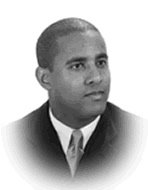
The photo and biographical information posted on his Web site indicate that Rep. Rutherford is my age or younger. Unless he has a physical condition that necessitates use of a motorized vehicle, why does he constrain himself to a golf cart when he could surely get to work under his own power? Could it be the heat? I have it on good authority that Columbia can be one of the hottest places in the known universe. Nope. High today should be around 89 degrees.
I think this might be the problem:
He said its only draw back is its lack of speed. He drives to the side to keep from being run over.
If he's worried about being hit in "his caution-yellow E-Z-GO," imagine how people on bicycles must feel! I appreciate this lawmaker's dedication to conserving fuel, but with such a short commute, I encourage him to leave the car and the golf cart in the garage. If I can do it, why can't he?
Wednesday, April 19, 2006
It's not easy being green
Thomas Friedman was on the Today Show this morning. He suggested that it would be a good thing if oil topped $100 a barrel as this would lead Americans to make other arrangements, as Kunstler might say. Faced with record high gasoline prices, he said, we would drastically change our habits. We would consume less oil. We'd make smarter choices about the types of cars we own. His theory goes something like this: Conservation would reduce demand, thus dropping the price of oil, which would allow us to stick out our collective tongues at Iran and other oil producing nations.
I hate to tell this to Friedman, but behavior modification will be a difficult assignment around these parts.
A local LEED-certified shopping center has recently become the subject of public scorn. Callers to the Savannah Morning News' "Vox Populi" gripe line have promised to boycott businesses in the Abercorn Commons, home to the planet's first LEED-certified McDonald's restaurant. The project's developer seems be doing everything right, from recapturing rainwater to energy efficient HVAC schemes to using recycled construction materials. It's the sort of development lots of cities would be proud to have, as Andre recently pointed out on his excellent blog.
What made the folks so angry? Some of the spaces in the permeable surface parking lot are set aside for hybrid cars. Here are some samples from Vox Populi:
With loyal customers like these, oil companies have little to worry about.
I hate to tell this to Friedman, but behavior modification will be a difficult assignment around these parts.
A local LEED-certified shopping center has recently become the subject of public scorn. Callers to the Savannah Morning News' "Vox Populi" gripe line have promised to boycott businesses in the Abercorn Commons, home to the planet's first LEED-certified McDonald's restaurant. The project's developer seems be doing everything right, from recapturing rainwater to energy efficient HVAC schemes to using recycled construction materials. It's the sort of development lots of cities would be proud to have, as Andre recently pointed out on his excellent blog.
What made the folks so angry? Some of the spaces in the permeable surface parking lot are set aside for hybrid cars. Here are some samples from Vox Populi:
"The 'Hybrid Vehicles Only' parking is ridiculous."
"Politically correct parking spaces for politically correct cars? I am physically handicapped and will spend my money elsewhere because I do not feel welcome there."
"I've been looking forward to the new stores but I don't drive a hybrid car, whatever that is, so I won't be shopping there."
With loyal customers like these, oil companies have little to worry about.
Tuesday, March 14, 2006
Leading cyclists in the wrong direction

Last week on the way to work, I saw a friend who was also commuting by bike. A couple days later, I talked with him on the phone and found that he rides to work pretty often. Why hadn't I seen him before? Because our paths diverge just north of Victory Drive. He joins the northbound Lincoln Street while I remain on Habersham Street.
He asked why I didn't follow the bike route and my answer was simple: wrong-way cyclists. As I have mentioned in previous posts, the Lincoln Street bicycle lane is on the left side of a northbound one-way street. Because it's the only marked bicycle lane in downtown Savannah, it naturally attracts cyclists and even those who need to go south. This forces them to ride against automobile traffic, which seems particularly dangerous at cross streets where motorists look for traffic originating from the south, but not necessarily the north.

It also requires northbound cyclists to play chicken with their southbound counterparts, which is why I steer clear of it all together. Here's one of the obstacles that I'd have to negotiate on my daily commute, if I used Lincoln Street. Add in a southbound cyclist nearing the tree at the same time and the game of chicken becomes even more exciting.
And, as the following photograph suggests, the bicycle lane provides very convenient parking for motorists.

The bicycle lane terminates at the intersection of Liberty Street, at which even law-abiding northbound bicyclists find themselves instantly on the wrong side of the road, facing oncoming traffic. (Lincoln becomes a two way street at this point). Turning right onto Liberty Street also presents problems for the northbound cyclist at this busy intersection.
But perhaps I'm making too much of this wrong-way cyclist thing.
Lincoln Street does have some advantages. First, there are stop signs at the inters
 ections of Anderson and Henry streets. This would probably make my commute quicker, as I would not have to wait for the traffic signals to change as I do on Habersham Street. This, by the way, seems to make motorists very uneasy. I suppose they are so used to seeing bicyclists blow the lights that they are freaked out when I don't.
Finally, there is something to be said for the idea of strength in numbers. Because Lincoln Street is popular with cyclists, perhaps motorists are more used to seeing them on the road. I am considering using Lincoln Street on my morning commute. Because I'm convinced riding against traffic is a terrible idea, I'll keep using Habersham Street on the way home. Anyone else out there have experience using "one-way" bike routes?
Friday, February 03, 2006
Breeding more bicycles
 Earlier this month, Bill Dawers wrote about the demolition of the City Market Parking Garage in his Savannah Morning News "City Talk" column. It was the destruction of City Market, for which the garage was named, that helped to spark Savannah's preservation movement in the mid 1950s. Lots of folks were happy to see the garage bite the dust. Commenting on a shuttle system deployed to soothe motorists until the new underground parking facility is built in its place, he wrote:
In many cities, commuters would think nothing of walking from Liberty and Jefferson streets, rather than taking a shuttle, but Savannahians are simply not accustomed to walking that far.
This is a puzzling, but very real phenomenon. Visitors travel from all over the globe to stroll the streets of the National Historic Landmark District, but to many locals, the idea of walking several blocks, through one of the most beautiful cities in the world, is intolerable.
And even if the city continues to add to its structured parking inventory, will it ever be able to keep pace with demand? If you believe Atlanta Journal-Constitution columnist Cynthia Tucker (and I do) the answer is no. If fact, she suggests that more parking breeds more cars. Writing last year about parking garages proposed for Atlanta's Piedmont Park, she observed:
Atlanta and every other Sun Belt city from Los Angeles to Orlando give the lie to the theory that it's possible to solve the issue of traffic and parking congestion by building more roads and more parking spaces. New roads and garages are the opposite of clothes dryers, where your socks are frequently kidnapped by forces unknown. Instead, cars self-multiply when you build more highways and garages. Park 10 in a garage overnight, and you'll have 15 in the morning.
Could the city of Savannah use this equation to it's advantage? If it provided free, secure, convenient, covered parking for bicycles, would more people consider riding bicycles around the National Landmark Historic District and thus reduce pressure on automobile parking resources? It's true that bicycles can be easily locked to parking meters, signposts and fences. But as a person who rode to work this morning on a saddle still soaked by yesterday's rain, I can tell you the idea of covered parking is appealing.
 Take a look at this photo of what I believe to be the only covered bicycle storage facility in downtown Savannah. Like virtually all bicycle racks in town, it is provided by the Savannah College of Art and Design and is free to use by students and non-students alike. It's safe to assume that most of these bicycles belong to students visiting the Jen Library, where the racks are located. But not all of them are.
Would Tucker's equation work for bikes? If you parked 10 at night, would you find 15 in the morning? Of course you'd have to figure a certain number would be lost to bicyle theivery, a thriving local cottage industry. Still, if parking decks attract more cars, then properly located and configured facilities should attract more bikes.
Wednesday, February 01, 2006
Former dealer warns users about addiction
I didn't watch President Bush's fifth State of the Union Address last night. But I read it on his Web site this morning. This is my favorite part:
Sounds pretty darn simple to me. A single chemical reaction? How hard could it be? Sort of difficult, it turns out.
This morning, the Savannah Morning News printed a story by Associated Press reporter Jennifer Loven. Here's a snip:
Our president has crafted a very instructive analogy: We are addicted to a drug called oil. And he should know. He's a former dealer. His observation about the oil coming from unstable parts of the world is also very keen. To feed our addiction, our Uncle Sam is constantly looking to score and that takes him into some of the sketchiest neighborhoods on the globe. He's obligated to do business with some pretty unsavory characters, all to make sure we don't go into withdrawal.
It seems to me, however, that even if we do manage engineer our nation's fleet of private automobiles to burn hydrogen, ethanol or Jesus Juice, we are essentially swapping one addiction for another. Instead of the street drug (oil) we'll be hooked on the pharmaceutical-grade stuff that Bush says his proposed 22 percent increase in clean energy research will deliver. And we will still have many of the same problems, at least in my town.
Hydrogen-powered vehicles will be lined up for miles in the eastbound lanes of Interstate 16 every workday morning. Neighborhoods will be bulldozed and all kinds of other expensive schemes floated to maximize ethanol-fueled vehicle volume and speed on Derenne Avenue. Owners of alternative fuel vehicles will still be clamoring for more structured parking in the National Historic Landmark District.
What if you can't afford to purchase or lease one of these new "clean" cars? What if a medical condition prevents you from operating one of these advanced vehicles? I'm sorry, friend, but in the future you'll be treated like a second class citizen, just as you are now.
A single chemical reaction between hydrogen and oxygen generates energy, which can be used to power a car -- producing only water, not exhaust fumes. With a new national commitment, our scientists and engineers will overcome obstacles to taking these cars from laboratory to showroom, so that the first car driven by a child born today could be powered by hydrogen, and pollution-free.
Sounds pretty darn simple to me. A single chemical reaction? How hard could it be? Sort of difficult, it turns out.
This morning, the Savannah Morning News printed a story by Associated Press reporter Jennifer Loven. Here's a snip:
"America is addicted to oil, which is often imported from unstable parts of the world," Bush said.
Our president has crafted a very instructive analogy: We are addicted to a drug called oil. And he should know. He's a former dealer. His observation about the oil coming from unstable parts of the world is also very keen. To feed our addiction, our Uncle Sam is constantly looking to score and that takes him into some of the sketchiest neighborhoods on the globe. He's obligated to do business with some pretty unsavory characters, all to make sure we don't go into withdrawal.
It seems to me, however, that even if we do manage engineer our nation's fleet of private automobiles to burn hydrogen, ethanol or Jesus Juice, we are essentially swapping one addiction for another. Instead of the street drug (oil) we'll be hooked on the pharmaceutical-grade stuff that Bush says his proposed 22 percent increase in clean energy research will deliver. And we will still have many of the same problems, at least in my town.
Hydrogen-powered vehicles will be lined up for miles in the eastbound lanes of Interstate 16 every workday morning. Neighborhoods will be bulldozed and all kinds of other expensive schemes floated to maximize ethanol-fueled vehicle volume and speed on Derenne Avenue. Owners of alternative fuel vehicles will still be clamoring for more structured parking in the National Historic Landmark District.
What if you can't afford to purchase or lease one of these new "clean" cars? What if a medical condition prevents you from operating one of these advanced vehicles? I'm sorry, friend, but in the future you'll be treated like a second class citizen, just as you are now.
Friday, December 30, 2005
My mind is in the gutter
There is a segment of the bicycling community that opposes the creation of bike lanes. One of the main gripes against bicycle lanes is practical: Bike lanes become repositories for road debris, which is particularly damaging to bicycle tires. Another argument is more philosophical: Bicycle lanes segregate cyclists to separate facilities. This is a slippery slope, they fear, ultimately leading to the exclusion of bicycles from streets without bicycle lanes. Some folks say, bike lanes are bike ghettos. It's a compelling argument.
 I use my city's only north-south bicycle lane on a daily basis, except the portion that runs along Lincoln Street. Lincoln is a one way street running north, making it completely inappropriate for a bicycle route. I quickly learned that riding my bicycle with traffic (as state law requires) would place me on a collision course with a relentless parade of wrong-way cyclists. No thanks.
Lately I'm becoming sympathetic to the first argument against bicycle lanes. South of Victory Drive, the Habersham Street bicycle lane is full of leaves. Some of these leaves have fallen directly from trees. Others have been moved from the yards of homes (including the yard of one prominent local official) into the bicycle lane.

These leaves don't pose much of a problem for me, as I usually ride on the left edge of the lane. However, they are a potential hazard for nighttime and rainy weather cyclists. Admittedly, this situation is seasonal. Once the trees have ejected all their leaves, the danger will diminish. However, in the spring the leaves will surely be replaced with mounds of grass clippings.
Other objects can be found in the bicycle lane at all times of year. I'd like to think that this truck was parked this way in an attempt to leave a portion of the bike lane clear. But I'm doubtful of good intentions in this case. The end result is that this truck is blocking a portion of the bicycle lane and all of the sidewalk. A police officer could have cited the owner of this truck for two different violations. I wonder how many police cruisers passed this location while the truck was parked there.
On a more positive note, while I was waiting at a traffic signal this morning a cyclist pulled up behind me. I turned around and said good morning. Not only was she riding on the correct side of the steet, but she also waited for the light to turn green! These two actions placed this cyclist delightfully at odds with most of the other bicycle operators I see every day. It was an after Christmas miracle!
Friday, December 23, 2005
Hari's today, gone tomorrow
Since I've been commuting by bicycle, I've seen two new restaurants open for business, watched the rehabilitation of a dilapidated house, and observed other houses become more dilapidated. Yet, I try to resist focusing too much attention on the residential and commercial structures I pass each day. Why? Because I have yet to encounter a building that was racing to beat me to the next traffic signal, stepping off the curb in front of me, or rolling straight toward me in the bicycle lane. There are plenty of motorists, pedestrians and wrong-way cyclists to perform those tasks, so I try to stay attentive to them.
One building I feel safe in inspecting closely is Hari's Food Store, a formidable contender for the title of Savannah's least attractive convenience store.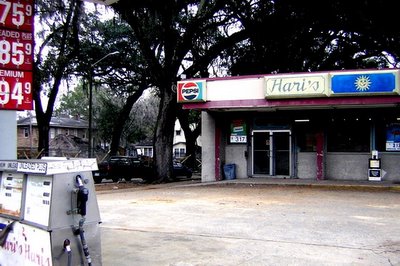
The reason I got into the habit of surveilling Hari's is this: It is source of successive waves of automobiles that flow into the roadway. The operators of these vehicles seldom show much regard for approaching cars and display absolutely none for approaching bicycles. I've found it pays to keep an eye on Hari's and prepare for evasive maneuvers, whether one is traveling down Habersham Street by bike, car, truck, sports ubiquity vehicle or M1 Abrams Main Battle Tank.
Last week, I noticed something different about Hari's. There weren't any cars were streaming out of the parking lot into my path. In fact, the store was locked and completely empty. While the lights were still on, the interior of the store was clearly devoid of shelving and merchandise.
One of my coworkers lives less than 200 yards from Hari's. I've heard him complain about Hari's for a reason different from my own: It is the source of successive waves of honey bun wrappers, empty beer bottles and losing scratch-off tickets that wash ashore in his front yard. I figured he'd be pleased that the place was locked up. When I asked him about it, he said he had no idea Hari's was closed.
Cars insulate us not just from the weather, but from the life of the neighborhoods through which we drive. To become aware of the subtle day-to-day changes in our communities, a different sort of vehicle is required. I'm lucky that I get to use such a vehicle almost every day.
One building I feel safe in inspecting closely is Hari's Food Store, a formidable contender for the title of Savannah's least attractive convenience store.

The reason I got into the habit of surveilling Hari's is this: It is source of successive waves of automobiles that flow into the roadway. The operators of these vehicles seldom show much regard for approaching cars and display absolutely none for approaching bicycles. I've found it pays to keep an eye on Hari's and prepare for evasive maneuvers, whether one is traveling down Habersham Street by bike, car, truck, sports ubiquity vehicle or M1 Abrams Main Battle Tank.
Last week, I noticed something different about Hari's. There weren't any cars were streaming out of the parking lot into my path. In fact, the store was locked and completely empty. While the lights were still on, the interior of the store was clearly devoid of shelving and merchandise.
One of my coworkers lives less than 200 yards from Hari's. I've heard him complain about Hari's for a reason different from my own: It is the source of successive waves of honey bun wrappers, empty beer bottles and losing scratch-off tickets that wash ashore in his front yard. I figured he'd be pleased that the place was locked up. When I asked him about it, he said he had no idea Hari's was closed.
Cars insulate us not just from the weather, but from the life of the neighborhoods through which we drive. To become aware of the subtle day-to-day changes in our communities, a different sort of vehicle is required. I'm lucky that I get to use such a vehicle almost every day.
Thursday, December 15, 2005
More posting than riding
Yesterday I wrote that I couldn't remember the last time I drove to work. But I can remember the last time I was driven to work. That was today. The threat of heavy thunderstorms and an office function at which unwet clothing was required kept me off my bike.
On the way to work not a drop of rain hit the windshield. Looks like the skies are clearing now. But that doesn't matter. I don't care if I get wet on the way home.
Tomorrow I ride!
On the way to work not a drop of rain hit the windshield. Looks like the skies are clearing now. But that doesn't matter. I don't care if I get wet on the way home.
Tomorrow I ride!
Wednesday, December 14, 2005
More riding than posting
The lack of activity on this blog could be interpreted as a sign that the Bike Year is over, that I abandoned the experiment. But, actually, the opposite is true. I've continued to ride on almost a daily basis. I honestly cannot remember the last time I drove to work.
Using my bicycle for tasks that previously would have placed me in the driver's seat is not really an "experiment" these days. It's part of my daily life. And I suppose that's why I haven't felt compelled to post in recent weeks. It all seems so unremarkable. I now understand why Bike Year hasn't attracted many visitors. It isn't terribly interesting. In fact, I guess it's pretty boring.
Still, as I peel months off the calendar, I've become aware that even though utility cycling has become my routine, it is always changing. The big change lately is the weather. Having lived in South Georgia and North Florida for most of my life, I've never owned a decent pair of gloves. Even when I lived downtown and walked a lot, I never bothered with gloves. After all, they are already sewn into jackets in the form of pockets.
Now, on cold mornings, I'm gripping the handlebars through $3 gloves I found years ago on the clearance table at the GAP. Finally I know why they were so cheap (aside the probable child labor and all that). These are not gloves, but more like hand costumes. They give the impression that I'm wearing gloves in much the same way that the Halloween costumes sold at K-Mart when I was a boy conveyed the notion of characters from "Star Wars." The wearer of the thin plastic jumpsuit with an image of C3PO on the chest was never mistaken for a real robot, nor did he or she ever really feel like a robot. In much the same way, my cold hands are acutely aware that they are not wearing real gloves, but merely an homage.
Wednesday, November 23, 2005
Different destinations, same mileage
When I started this blog back in July, most of my cycling was done after work. Back then, Savannah's legendary heat and humidity made it impossible for me to commute to work in business attire. As a result I did most of my cycling after work in the form of rides to the grocery store, minor league ballpark, library, restaurants, bike shop and video rental store. I wasn't wearing a suit and tie on these trips.
Since sometime in late September (I really should have kept track or this), most of my rides have taken me to work and back. It's been a very dry fall and I've taken full advantage of this by commuting to the office almost every day. Once I arrive at home, the bike goes into the shed and it usually doesn't emerge until the next day. Nonetheless, I don't think I'm driving more, even though I've cut back on riding after work.
What's happening, I've discovered, is that I'm bundling my trips together. I'm shopping more often at the Gwinnett Street Kroger, which is between my house and the office, and less often at Publix, which is about two miles south of my home. I'm taking care of errands along my commuting route. I'm also shopping more on foot during my lunch break.
Wednesday, November 02, 2005
The view from the Habitrail
I've recently returned from a five day visit to Kansas City, during which I saw three bicyclists. But perhaps I wasn't looking in the right places. I was confined, for most of my stay, to the Crown Center complex, which according to the 30-year-old postcard I bought in the gift shop off the Westin Hotel lobby, was conceived as "America's first downtown suburb." Whatever that means.
There was little humanoid activity on the sidewalks around the Crown Center, thanks to an oversized Habitrail known as "The Link." It allows pedestrians to walk all the way from Hallmark headquarters to the beautiful Union Station. Along the way, interpretive displays help Link users identify the buildings and other structures they observe through the glass. That way they don't actually have to walk on the sidewalk, like common animals, to find out what's what.
Over the next week or so, I'll be posting photographs from Kansas City on my photoblog, which is located here.
Wednesday, October 12, 2005
Easier in a car
I recently listened in on several SCAD students debating the practicality of living without a car in downtown Savannah. Bicycle ridership is probably higher among college students than any other demographic group in the country. Getting a new bicycle for the first year on campus, then having it promptly stolen, is a rite of passage for American students. They may put more miles on their bikes during college than they will for the rest of their lives.
Still, some college students cling steadfastly to their cars even in an environment in which automobiles can be a liability.
One student asked an avid cyclist how he transported himself to the malls, both of which are located on Abercorn Extension, Savannah's main corridor of commercial sprawl. His response was classic: "Malls are everything I hate all in one place, so they are easy to avoid." Another asked a car-free peer how she planned to get to Kroger for groceries when it was raining. Would she still be riding her bike then? Her response was right on target. "Probably," she said. "But I might just put on my raincoat, grab my umbrella and walk."
Still, the car cartel wouldn't be swayed. They might concede that life without a car was possible, but some things, they argued, are just easier in a car.
Later in the week I was walking near the intersection of Gwinnett and Lincoln streets. Lincoln is a one-way street at this location, with a single lane available to automobile traffic. There's a bicycle lane on the west side of the street and parking on the east.
I observed a woman leaning up against a sedan chatting with the occupants. Soon, the person in the driver's seat said,"Well, I'll see how far I can make it." Her friend stepped onto the sidewalk and the car lurched into traffic and headed north at about 2 miles per hour. I noticed that the car's right rear tire was flat. Because I was walking in the same direction and moving at almost precisely the same speed as the car, I had an ideal vantage point from which to observe the drama as it began to unfold.
Pretty soon half a dozen other cars were stacked up behind the slow-moving automobile. The operators of these vehicles telegraphed their displeasure by honking their horns and trying to pass in the bike lane. The woman in the wounded car responded by leaning out of her window, turning her head and torso toward the trailing cars and enthusiastically screaming an impressive repertoire of obscenities. Some of the other motorists responded in kind.
I'm not sure who exactly who was driving the woman's car during her exchange with her fellow motorists, because her top half was totally outside the car. She was using both hands to vigorously emphasize the words she was shouting. I suppose the young child in the front seat might have taken the wheel. Eventually, the car turned onto the side street and the disgruntled motorists angrily accelerated to reclaim the 45 seconds that had been stolen from them.
I sometimes see similar behavior in motorists, who are irritated by having to wait to pass me. However, I couldn't create anything close to the Parade of Vehicular Hostility described above, even if I rode my bike in the middle of the street. After all, some things are just easier in a car.
Thursday, October 06, 2005
I'm a fairweather cyclist
One day after my self-righteous comments about single-occupant automobiles, I proved myself to be a big ol' hypocrite. Doubt me? Dig this: I drove to a local observance of International Walk to School Day.
I played a minor role in this event and needed to transport some materials that were too cumbersome to move on my bike. But that's really just an excuse. I'm sure I could have done it had I put some thought into it. It felt lousy to be behind the wheel for such a short trip.
Driving home from work, however, I must admit was truly glad to be in the car. I saw a cyclist with plastic bags on his shoes. His head was lowered as he bravely trudged along. The plastic bags and bravery were necessary because this fellow's ride coincided with landfall of Tropical Storm Tammy. Heavy rain and windblown debris do not make for pleasant cycling. Factor in power outages that disable street lighting and traffic signals and you've got a pretty inhospitable bicycling environment.
I'm proud of the miles I put on my bicycle last month. But I shouldn't be. Very little rain fell locally in September and the temperatures were mild. It doesn't take much dedication to ride a bike under these conditions. There are folks who cycle straight through blizzards, sandstorms, black ice, earthquakes, geyser eruptions, meteor showers and all sorts of other terrible stuff.
This morning's commute was just a bit difficult because of the severed tree parts left behind by the storm. The streets were littered with sweetgum and pecan branches. And palm fronds. This forced me to ride further left than I normally do. Fortunately, most motorists who passed me gave me a little more room than usual.
I encountered another cyclist riding ahead of me just north of 37th Street. He stopped briefly at Anderson Street before riding through the red light. He did the same thing at Henry Street. Legally, only law enforcement officers and drivers of emergency vehicles can elect not to respect red lights. Clearly this cyclist was a very important person on very important business. I presume lives were at stake.
I waited at both intersections for my turn to cross. Still, I reached Gwinnett Street only 10 seconds after he did, riding at my normal (slow) pace.
Tuesday, October 04, 2005
Still cheap enough to waste
Regular gasoline prices in Savannah are hovering around $3.20 per gallon. The president of the United States of America has urged citizens to conserve fuel. News stories like this suggest bicycles are selling smartly, as motorists grow weary of pouring their paychecks into holes in the sides of their cars.
Yet I've detected little change on the streets of this town. On my commute to work, I see only a handful of other cyclists, but plenty of single occupant automobiles.
I don't expect to people to divest themselves of fuel-inefficient vehicles overnight, but I am surprised to see them left idling for half an hour in the fire lane outside the supermarket. Or for 15 minutes at the front door of the video store. I'm puzzled to see people treating traffic signals like the Christmas tree at the Savannah Dragway, stomping on the accelerator for the holeshot and best E.T. to the next intersection.
Having witnessed this sort of behavior again and again over the last couple weeks, I can only conclude that gasoline is still cheap enough to waste. At least on some things.
Georgia Gov. Sonny Perdue effectively shut down the state's public school system for two days last week to conserve fuel. I liked what Atlanta Journal-Constitution columnist Jay Bookman had to say about this in his column Fool shortage? Unfortunately, not in Georgia (registration may be required). Here's a snip:
Lumbering school buses and evil convenience store owners, they make excellent scapegoats. By focusing our blame on them, we can avoid facing the real problem that got us into this mess: our lifestyles and driving habits, which are too often the same thing.
Yet I've detected little change on the streets of this town. On my commute to work, I see only a handful of other cyclists, but plenty of single occupant automobiles.
I don't expect to people to divest themselves of fuel-inefficient vehicles overnight, but I am surprised to see them left idling for half an hour in the fire lane outside the supermarket. Or for 15 minutes at the front door of the video store. I'm puzzled to see people treating traffic signals like the Christmas tree at the Savannah Dragway, stomping on the accelerator for the holeshot and best E.T. to the next intersection.
Having witnessed this sort of behavior again and again over the last couple weeks, I can only conclude that gasoline is still cheap enough to waste. At least on some things.
Georgia Gov. Sonny Perdue effectively shut down the state's public school system for two days last week to conserve fuel. I liked what Atlanta Journal-Constitution columnist Jay Bookman had to say about this in his column Fool shortage? Unfortunately, not in Georgia (registration may be required). Here's a snip:
We may bounce around the bottom in SAT scores, and almost half of our kids may leave school without a diploma, but hey, what's really important is saving enough gas to run our SUVs, right?Is our governor suggesting that school busses, perhaps the most efficient motor vehicles on Georgia roads when it comes passenger miles per gallon, are the problem? Or is it filling station owners? Local television news broadcasts endlessly repeat gouging hotline numbers motorists may ring if they suspect their local gasmonger is trying to cheat them.
Sorry, I just can't get over the stupidity of that move. Forget the inconvenience to parents caused by Gov. Sonny Perdue's sudden announcement. Forget its utter futility in terms of energy saved. Think instead about the symbolism of it -- to our children, to their teachers, to businesses thinking of locating here.
When things get just a little bit tough, when it's time to separate the necessary from the frivolous, what do our leaders instinctively offer up for sacrifice? Education.
Or, to ask it another way, what does it tell you when high school is canceled, but high school football games aren't?
Lumbering school buses and evil convenience store owners, they make excellent scapegoats. By focusing our blame on them, we can avoid facing the real problem that got us into this mess: our lifestyles and driving habits, which are too often the same thing.
Thursday, September 22, 2005
Happy World Car Free Day!
Today is World Car Free Day. But I didn't need to look at a calendar to know that. On my 2.5-mile ride to work this morning, I shared the streets with hundreds of other cyclists. All sorts of people were on all sorts of bicycles, including several Free Spirit 10-speeds, still covered with dust from decades of slumber in the dark corners of Savannah's garages.
Bicycles were everywhere. In fact, the only motor vehicles I saw were the local bike shops' support trucks slowly prowling Habersham Street. The trucks were soon parked and the air compressors, tools and other repair gear transferred to a fleet of Xtracycles, from which volunteer mechanics continued lending aid to cyclists whose long-neglected rides weren't quite prepared for the morning commute.
Shops and restaurants all over town were brimming with customers. Unencumbered by the need to find suitable storage places for their automobiles, they easily wheeled up to bike racks that had been deployed in advance of today's event. And they didn't even worry about locking their bikes. A wave of goodwill had spread among the cycling citizens, making the prospect of theft very unlikely.
Around 8:30 a.m., President Bush announced in a press conference that he wanted all spending on new road construction, included in the $286 billion federal highway bill passed in July, redirected to fund mass transit and to begin modification of our nation's roadways to safely accommodate bicycle and pedestrian traffic. In an announcement that shocked just about everyone, President Bush said, "It's sort of like I've been born again, again. I now realize that continued spending on automobile-exclusive infrastructure only digs us deeper into a hole from which America would never emerge."
After the press conference, Bush hopped on his mountain bike and rode from the White House to Capitol Hill to discuss his epiphany with legislators, who were also commuting to work by bicycle.
###
My 2.5-mile ride to work looked pretty much like it did yesterday. I saw a city worker headed south on an old blue Schwinn. I saw man riding against traffic on a child's bike. I saw a handful of SCAD students cycling to class. I saw a Trek road bike being loaded into the cargo hold of a Chevy Suburban. I saw one other bicycle in the rack outside my office.
On a more positive note, here's this and this.
Wednesday, September 21, 2005
Free from cars, but not from responsibility
I learned last week about Car Free Savannah, a new local advocacy organization focused on "human powered transportation." There's a lot to like in the group's mission statement and I'm looking forward to seeing what they accomplish. However, I disagree with some of the advice for pedestrians and cyclists dispensed in the "How Not to Drive" section of the Car Free Savannah Web site. For example I offer this passage:
Yesterday on my ride home from work, I was passed by a cyclist who was taking the lane. No problem there, except that he sailed straight across Victory Drive against the light in the left turn lane. From there he continued riding the centerline of Habersham Street, so that cars were squeezing between him and another cyclist riding in the bike lane. I presume he was making up his own rules to a game he wasn't invited to play.
About an hour later, I took a spin around the neighborhood on my new single speed bicycle (more about it in a future post). I nearly collided with a cyclist in full costume who crashed a stop sign at the corner of 49th Street and Atlantic Avenue. The only thing that alerted him to my presence was the shriek of a 26-year-old Mafac Racer brake. If I had been driving a car, he would have likely ended up on its hood. I suppose he didn't require a sign to tell him what to do.
If these two characters are "experienced cyclists," I hope I never become one.
It seems to me that bicyclists sometimes want it both ways. We want respect from motorists and full access to the streets. Yet, we exempt ourselves from the rules of the road. Which is it? I don't see how we can expect to be protected by the law while simultaneously placing ourselves above it.
Same road, same rules, same rights?
Kind of.
A bicycle is supposed to follow all the rules of traffic, just like a car. In practice, though...
Experienced cyclists rarely wait for a red light to change. Cyclists don't require signals to tell them about what other cars are going to do. They have no blind spots, can hear their surroundings, and aren't likely to be moving more than 20 miles an hour. If they are, they're definitely paying attention.
If you watch an intersection where cyclists regularly cross, you'll notice that they're watching traffic, not lights. It doesn't matter what color some bulb is, either a vehicle is coming, or it isn't. Car accidents happen because drivers trust that a glowing bulb means the coast is clear, or that a one-way sign will keep traffic flowing in one direction.
Bicycles are not often considered when traffic laws are written, roads are built, or communities are 'planned'. After riding for a while, most cyclists see traffic laws as rules to a game they're not invited to play.
Yesterday on my ride home from work, I was passed by a cyclist who was taking the lane. No problem there, except that he sailed straight across Victory Drive against the light in the left turn lane. From there he continued riding the centerline of Habersham Street, so that cars were squeezing between him and another cyclist riding in the bike lane. I presume he was making up his own rules to a game he wasn't invited to play.
About an hour later, I took a spin around the neighborhood on my new single speed bicycle (more about it in a future post). I nearly collided with a cyclist in full costume who crashed a stop sign at the corner of 49th Street and Atlantic Avenue. The only thing that alerted him to my presence was the shriek of a 26-year-old Mafac Racer brake. If I had been driving a car, he would have likely ended up on its hood. I suppose he didn't require a sign to tell him what to do.
If these two characters are "experienced cyclists," I hope I never become one.
It seems to me that bicyclists sometimes want it both ways. We want respect from motorists and full access to the streets. Yet, we exempt ourselves from the rules of the road. Which is it? I don't see how we can expect to be protected by the law while simultaneously placing ourselves above it.
Wednesday, September 14, 2005
Bike Year down shifts to one gear
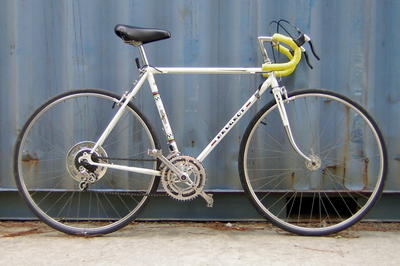
I had to work last weekend and I rode my 1979 Peugeot UO-10 instead of my normal utility bicycle. On the way home Sunday afternoon, a guy in bike shorts and a jersey pulled up beside me on his nice Trek. We rode along enjoying a pleasant discussion about local cycling routes. Eventually he became impatient with my leisurely pace and took his leave. Still, this is the most contact I've had with a roadie to date. I ride in street clothes and I'm slow, so I sometimes perceive that the people in full cycling costumes flying past me on their slick road bikes are looking down their noses at me and my humble conveyance.
Riding the UO-10 for the first time in months made me aware that my utility bike is pretty clunky. I realize that the person riding the bike is the predominant factor in how fast it goes, but the Peugeot certainly ate up the pavement in big bites. I don't know exactly what came over me when I got home, but I got the notion that I should convert the UO-10 into a single speed bike.
Before I knew it, I'd removed the rear brake, a chain ring, the front and rear derailers, shifters and all associated cables. I shortened the chain. I wrapped the chain around one of the cogs (This is an inelegant solution, I know). The 27 inch Rigida rims were replaced by 700c Arayas from a donor bike. I rode it around the neighborhood and liked the results.
Phase two of the transformation is scheduled for tomorrow. It will include a procedure I've never undertaken before: a pedal transplant. Below is a photo of the UO-10 before I started removing parts. I'll post a post-op photo once the patient is in recovery.
Riding the UO-10 for the first time in months made me aware that my utility bike is pretty clunky. I realize that the person riding the bike is the predominant factor in how fast it goes, but the Peugeot certainly ate up the pavement in big bites. I don't know exactly what came over me when I got home, but I got the notion that I should convert the UO-10 into a single speed bike.
Before I knew it, I'd removed the rear brake, a chain ring, the front and rear derailers, shifters and all associated cables. I shortened the chain. I wrapped the chain around one of the cogs (This is an inelegant solution, I know). The 27 inch Rigida rims were replaced by 700c Arayas from a donor bike. I rode it around the neighborhood and liked the results.
Phase two of the transformation is scheduled for tomorrow. It will include a procedure I've never undertaken before: a pedal transplant. Below is a photo of the UO-10 before I started removing parts. I'll post a post-op photo once the patient is in recovery.

Subscribe to:
Posts (Atom)
